
Free Dilution Calculator – Calculate Solution Dilution Accurately
Use our free Dilution Calculator to calculate solution dilution instantly. Supports C1V1=C2V2, molarity, ppm, mg/ml, percentage, and ratio dilution.
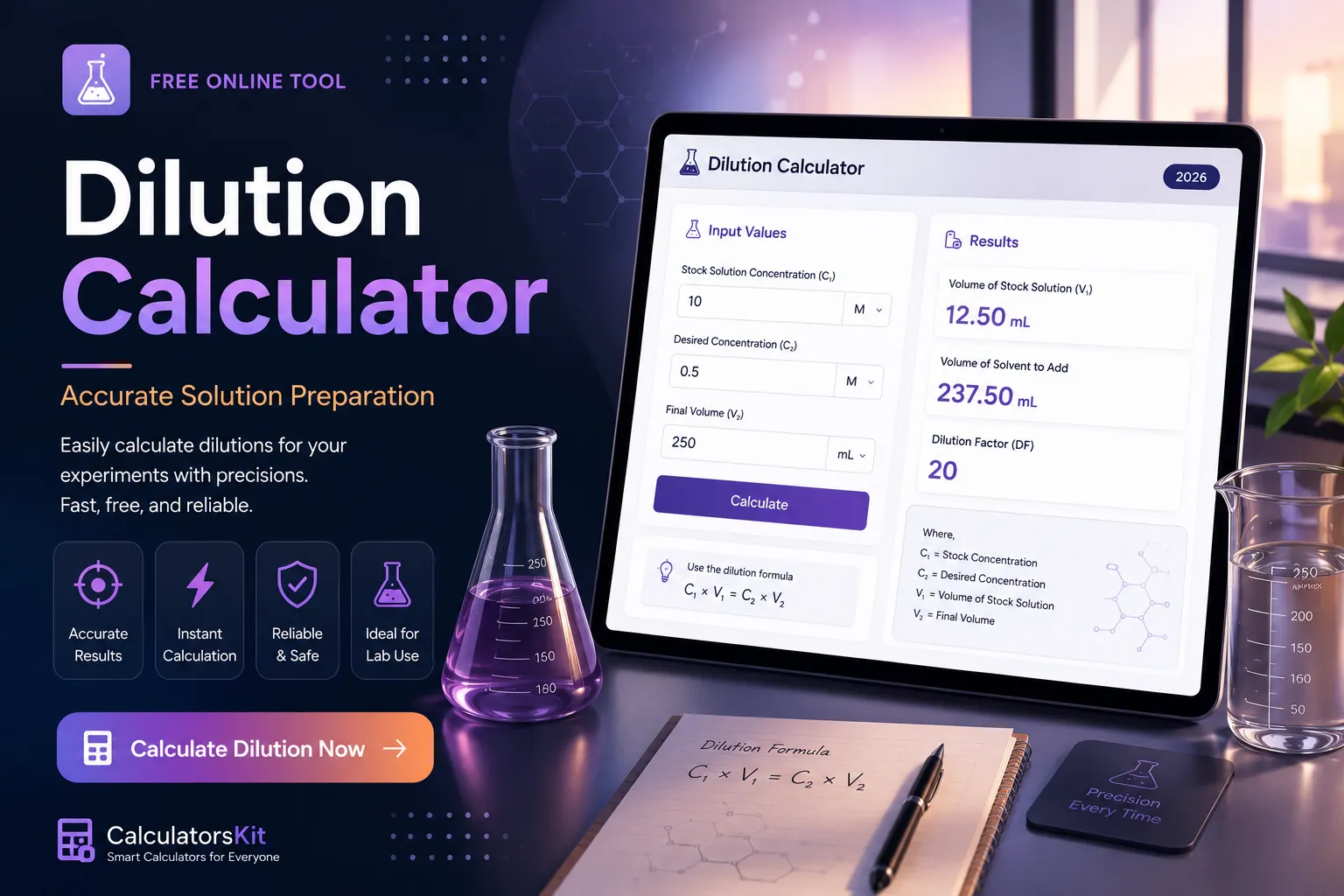
A dilution calculator solves one problem: turning a concentrated solution into a weaker one without guesswork. Whether you measure molarity in a lab, mix detailing chemicals by the ounce, or brew beer and need a target ABV, one wrong ratio can ruin a batch, waste product, or skew a result.
This guide covers every major type of dilution calculation people search for, including molarity, percentage, mg/ml, ppm, ng/ul, and the ratio-based dilutions used in detailing, brewing, and alcohol proofing. You will get the exact formulas, a manual step-by-step method, the mistakes people make most often, and a checklist you can reuse every time you mix a solution.
By the end, you will know which formula fits your situation, and how to check any dilution calculator's output by hand in under a minute.
What a Dilution Calculator Actually Does
A dilution calculator works out how much stock solution and how much diluent, usually water or a solvent, you need to hit a target concentration in a set final volume. It removes the manual math, but understanding what happens behind the tool matters more than most people realize.
Here is why it matters: every dilution calculator, no matter how well built, depends on three numbers you enter correctly: starting concentration, target concentration, and final volume. If one of these is wrong, the output is wrong, even though the math itself is flawless. This is the number one reason people get inconsistent results from calculators they trust.
Dilution errors compound depending on the field:
Laboratory work: a 2x concentration error can invalidate an entire experiment or assay.
Detailing: an over-diluted chemical fails to clean; an under-diluted one damages surfaces and wastes product.
Brewing: an incorrect dilution shifts final ABV and throws off carbonation and flavor balance.
Food, water treatment, and pharma settings: a ppm error can breach a safety threshold without anyone noticing until testing.
A calculator speeds up the arithmetic. It does not replace understanding the formula that sits underneath it, and that formula is the same one for almost every use case.
The Core Dilution Formula Behind Every Calculator
Nearly every dilution calculator on the market, regardless of the units shown on the screen, runs on one relationship:
C1 × V1 = C2 × V2
Where:
C1 = starting concentration of your stock solution
V1 = volume of stock solution you need to measure out
C2 = target (final) concentration you want to end up with
V2 = total final volume of the diluted solution
This one equation covers molarity, mg/ml, percentage, and ppm dilutions. Only the units on either side change; the logic never does.
This relationship comes directly from the conservation of solute: the amount of substance stays the same before and after dilution, only the volume changes. For the full derivation and underlying chemistry, Chemistry LibreTexts covers the solute-conservation proof behind C1V1 = C2V2 in more academic depth than this guide needs to cover.
How to Solve It Step by Step
Write down what you already know: starting concentration, target concentration, and target final volume.
Rearrange the formula to solve for the unknown, usually V1: V1 = (C2 × V2) ÷ C1.
Plug in your numbers and solve for V1, the amount of stock solution to measure.
Subtract V1 from V2 to find how much diluent to add: Diluent = V2 − V1.
Measure the stock first, then top up with diluent to the final volume, not the other way around.
Worked example: you have a 5 M stock solution and need 500 ml of a 0.5 M working solution.
5 × V1 = 0.5 × 500, so V1 = 250 ÷ 5 = 50 ml. You measure 50 mL of stock and add 450 mL of diluent to reach 500 mL total.
Types of Dilution Calculations, and Which One You Need
Most searches for a dilution calculator fall into five groups. Knowing which group your task belongs to is the fastest way to avoid a wrong result.
Molarity Dilution Calculator (mol/L)
Used in chemistry, pharmacology, and cell biology, where concentration is expressed in moles per litre. The formula is the standard C1V1 = C2V2, with both concentrations in the same molar unit (M, mM, or µM). A common trap: mixing millimolar and micromolar values without converting first. Always convert both sides to the same unit before solving.
Percentage Dilution Calculator
Common for cleaning products, disinfectants, and w/v or v/v solutions such as bleach or saline. The formula becomes C1(%) × V1 = C2(%) × V2. Percentage dilutions confuse people because a 10% solution diluted to 1% is a 1:10 dilution, not a 10:1 one; the bigger the drop in percentage, the more diluent, not stock, you need.
Mass per Volume (mg/ml, µg/ml, ng/µl) Dilution Calculator
This group covers most pharma, drug-prep, and cell-culture searches. The relationship is identical: C1(mg/ml) × V1 = C2(mg/ml) × V2. The real danger here is not the math; it is unit mismatch. Note the equivalence below before you calculate anything:
1 mg/ml = 1,000 µg/ml = 1,000 ng/µl
1 µg/ml = 1 ng/µl
A missed decimal shift between mg and µg is the single most common lab dilution error
PPM (Parts Per Million) Dilution Calculator
Used in water treatment, agriculture, food safety, and environmental testing. The formula is the same structure: ppm1 × V1 = ppm2 × V2. For context, 1% concentration equals 10,000 ppm, so converting between percentage and ppm before you dilute prevents a decimal-place disaster that is easy to miss until the batch is already mixed.
Because ppm work often ties back to legal safety limits, it is worth checking your target concentration against a regulatory source rather than assuming a round number is safe. The EPA's drinking water regulations page lists enforceable maximum contaminant levels for reference.
Ratio-Based Dilution (Detailing, Brewing, Alcohol, oz Measurements)
This group works differently, and it is where most people get tripped up because they try to force the C1V1 formula onto a ratio problem. A ratio dilution like 1:10 or 1:256 does not describe a concentration change from a known stock; it describes parts of product to parts of water.
The correct approach for ratio dilutions:
Add the two numbers in the ratio to get the total number of parts. A 1:10 ratio has 11 total parts.
Divide your container size by the total parts to find the size of one part.
Multiply that single-part size by 1 to get the product amount, and by the remaining parts for the water amount.
Example: a 32 oz detailing bottle mixed at 1:10. Total parts = 11. One part = 32 ÷ 11 ≈ 2.9 oz. That means roughly 2.9 oz of concentrate and 29.1 oz of water.
Manual Calculation Walkthrough for Every Industry
The table below applies the same underlying logic to five different fields, so you can see how one formula framework covers every query type.
Field | Typical Unit | Formula to Use | Example Result |
|---|---|---|---|
Laboratory chemistry | Molarity (M) | C1V1 = C2V2 | 5M to 0.5M in 500ml = 50ml stock |
Pharma/cell biology | mg/ml, µg/ml, ng/µl | C1V1 = C2V2 (convert units first) | 10mg/ml to 1mg/ml in 100ml = 10ml stock |
Water / environmental | ppm | ppm1V1 = ppm2V2 | 1000ppm to 100ppm in 1L = 100ml stock |
Detailing / cleaning | Ratio (1:X) | Container size ÷ total parts | 1:10 in 32oz = 2.9oz product |
Brewing/alcohol | ABV %, Pearson's Square | Cross-difference ratio method | Blend high-proof + water to target ABV |
Real-World Use Cases and Practical Examples
Laboratory and Life Science Work
Researchers preparing serial dilutions for assays, or making working solutions from a concentrated stock, rely on the C1V1 formula dozens of times a week. Tools built for this workflow, similar in purpose to GraphPad's dilution calculator, Tocris's solution calculator, or Physiology Web's dilution tool, all solve the same equation but present it around molarity, mg/ml, or stock-solution prep. The practical skill is not memorizing any single tool's interface; it is knowing how to rearrange C1V1 = C2V2 for whichever variable is missing, so you are never stuck if a specific calculator is down or does not support your unit.
Car Detailing Chemical Dilution
Detailing products are almost always sold as concentrates with a ratio on the label, such as 1:4 for interior cleaner or 1:20 for a snow-foam pre-wash. Detailers who eyeball ratios instead of measuring waste far more product over a year than the five extra seconds a proper measurement takes. A cheap ounce-marked mixing bottle pays for itself within a month for anyone mixing chemicals regularly.
Home Brewing Dilution
Brewers dilute high-gravity beer or concentrated wort to hit a target original gravity, or blend water into a finished batch to adjust ABV before bottling. Because alcohol and water do not mix in a perfectly linear volume (the total volume after mixing is slightly less than the sum of the two), brewers doing precise ABV work should treat calculator output as a strong estimate and confirm with a hydrometer or refractometer reading rather than trusting the number blindly.
Alcohol Proofing and Dilution
Spirits producers who cut high-proof alcohol down to bottling proof often use the Pearson's Square method rather than a straight C1V1 formula because it accounts for two known concentrations being blended (high-proof spirit and water) rather than a stock being diluted into a single unknown. The square method: place the target proof in the centre, subtract diagonally across the two starting values, and the resulting differences give you the mixing ratio directly.
Common Mistakes People Make When Calculating Dilutions
Mixing units without converting first, such as entering mg/ml on one side and µg/ml on the other.
Confusing a ratio dilution (1:10) with a fraction dilution (1/10), which are not always the same final concentration depending on how the product defines its ratio.
Adding diluent before measuring the exact stock volume, which throws off the final total volume.
Assuming percentage and ppm are interchangeable without applying the 1% = 10,000 ppm conversion.
Treating a calculator's output as final without a sanity check, especially when a typo in concentration produces a result that is off by a factor of 10 or 1000.
Ignoring temperature and solute effects on final volume in precise lab or alcohol-proofing work, where mixed volumes are not always perfectly additive.
Rounding too early in multi-step calculations, which compounds small errors into a meaningfully wrong final answer.
Dilution Calculator Checklist: Before You Mix
Run through this list every time, regardless of which calculator or formula you use. It takes under a minute and prevents the vast majority of dilution errors.
Confirm the unit of your stock concentration and your target concentration match before entering numbers.
Double-check whether your task needs a concentration formula (C1V1 = C2V2) or a ratio formula (parts of product to parts of diluent).
Write down the final volume you actually need, not an approximate amount.
Calculate stock volume first, then diluent volume as the remainder, never both independently.
Re-run the calculation with rounded numbers as a rough sanity check against the calculator's exact output.
Label the final container with the concentration and date, especially for lab or chemical solutions that will sit for more than a day.
For high-stakes work, such as pharma prep or alcohol proofing, confirm the result with a physical measurement tool, not the calculator alone.
Manual Calculation vs Online Dilution Calculator Tools
Both approaches have a place, and the right choice depends on how often you dilute and how much precision the task demands.
Factor | Manual Calculation | Online Dilution Calculator |
|---|---|---|
Speed for a single dilution | Slower, more room for arithmetic slips | Faster, fewer manual steps |
Best for | Learning the logic, spot-checking a tool | Repeated dilutions, complex unit conversions |
Error risk | Higher with multi-step unit conversion | Lower, but only if inputs are correct |
Works offline | Yes, always | Depends on the tool |
Builds understanding | Yes, directly | Not on its own |
The strongest workflow combines both: use a calculator for speed on repeated tasks, and run a quick manual check with the C1V1 formula whenever the result matters, the numbers are unusual, or you are working with a new unit for the first time.
Conclusion
Every dilution calculator, regardless of the label on the page, either solves C1V1 = C2V2 for a concentration-based dilution or applies a parts-based ratio for a mixing-based dilution. Once you can tell which type your task is and rearrange the right formula by hand, the calculator becomes a speed tool rather than a black box you have to trust blindly. Run the checklist above before every mix, and you will catch the small input errors that cause most real-world dilution mistakes.
Frequently Asked Questions
Q: How do I use a dilution calculator for mg/ml?
Enter your stock concentration and target concentration in the same mass-per-volume unit, then enter your target final volume. The calculator applies C1V1 = C2V2 and returns the stock volume needed; the remainder up to your final volume is diluent.
Q: How is a molarity dilution calculator different from a percentage one?
They use the identical formula structure, C1V1 = C2V2. The only difference is the unit on each side: moles per litre for molarity, and percentage concentration (w/v or v/v) for percentage dilutions. Neither can be mixed with the other without converting first.
Q: What is the formula for a ppm dilution calculator?
ppm1 × V1 = ppm2 × V2, following the same logic as molarity and percentage dilutions. Convert to percentage first if your source concentration is only given as a percentage, using 1% = 10,000 ppm.
Q: How do I calculate a dilution ratio in oz for detailing or brewing?
Add both numbers in the ratio to get total parts, divide your container size in ounces by the total parts to get one part, then multiply by the product side and the water side separately.
Q: Do tools like GraphPad, Tocris, or Physiology Web calculate dilutions differently?
No. Lab-focused calculators built for research workflows apply the same C1V1 = C2V2 formula; they differ mainly in interface, unit presets, and whether they support serial dilution series rather than a single calculation.
Q: Can I use the same formula for alcohol dilution and proofing?
Not directly. Straight C1V1 works reasonably for rough estimates, but precise alcohol proofing typically uses the Pearson's Square method because volumes are not perfectly additive when mixing alcohol and water.
Related Articles

Use our free cubic feet calculator to calculate box, tank, wood, soil, and storage volume accurately from feet, inches, or cm.

Use a free overtime calculator to calculate overtime pay from an hourly or monthly salary. Learn formulas, rates, Pakistan rules, and common mistakes.

Calculate your exact age from your date of birth instantly. Free Age Calculator with years, months, days, birthday countdown, and leap year accuracy.

Use our free Health Calculator to calculate BMI, BMR, and TDEE instantly. Get accurate calorie needs, healthy weight insights, and fitness results.