
How to Calculate Molar Mass & Use a Concrete Estimator
Learn how molar mass and concrete calculators improve accuracy in chemistry and construction. Simple, practical, and perfect for real-world applications.
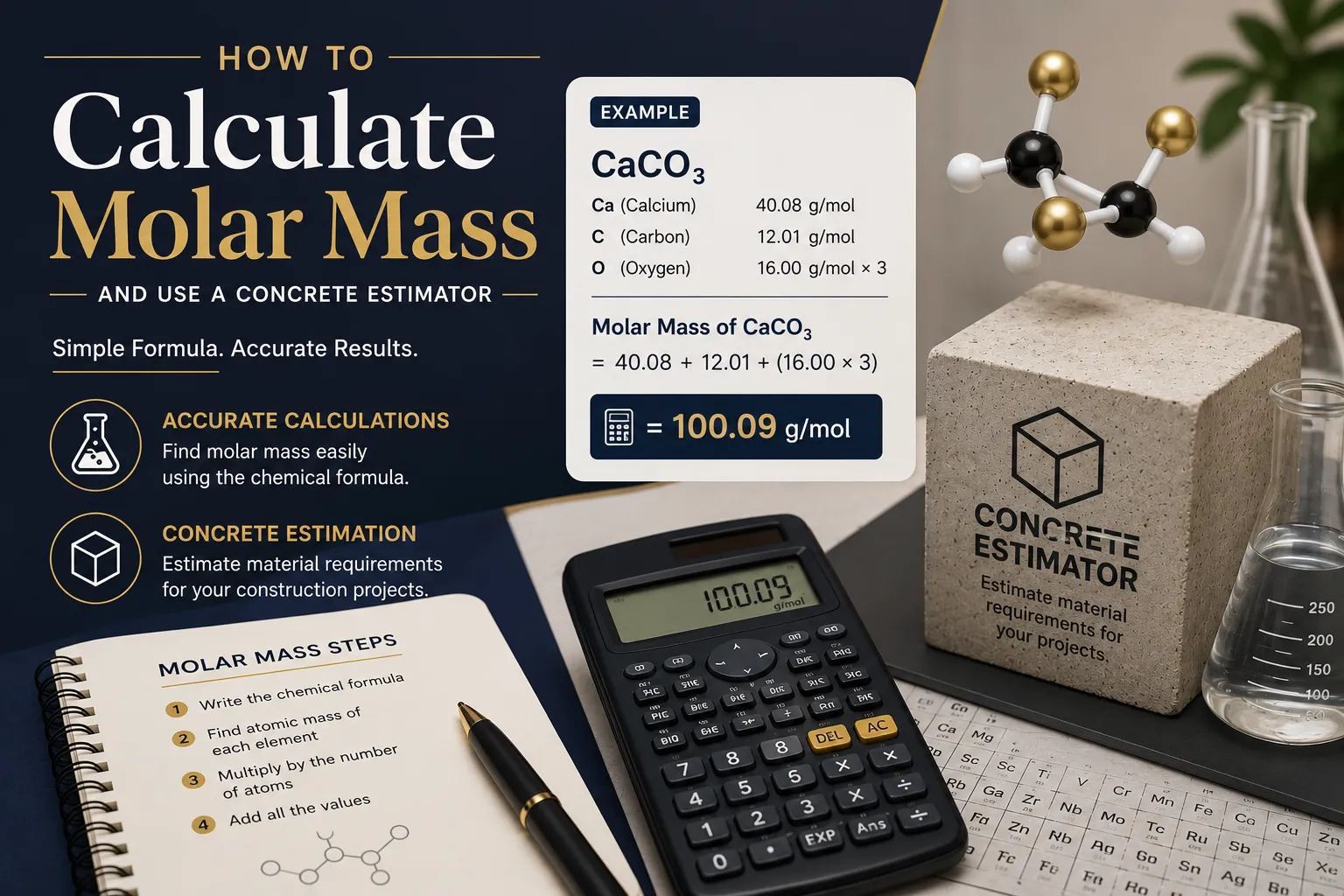
Featured Snippet Answer Molar mass is the mass of one mole of a substance, measured in grams per mole. To calculate it, multiply the atomic mass of each element in the formula by how many times that element appears, then add every result together. Water, for example, has a molar mass of 18.02 grams per mole, calculated from two hydrogen atoms and one oxygen atom. |
What Is Molar Mass
Molar mass tells you how many grams make up one mole of a substance, where a mole represents a fixed count of particles, roughly 6.022 times ten to the twenty-third. It uses the unit grams per mole, often written as g per mol. Molar mass connects the microscopic world of atoms to the macroscopic world of a lab scale, which is why every stoichiometry calculation eventually passes through it. Without molar mass, a chemist could weigh out a substance but never know how many actual molecules that weight represents.
Molar Mass Formula Explained
The molar mass of a compound equals the sum of the atomic masses of every atom in its formula, each multiplied by how many times that atom appears. Atomic masses come from the periodic table, listed under each element's symbol. A subscript in a chemical formula tells you how many atoms of that element exist in one unit of the compound, so H2O contains two hydrogen atoms and one oxygen atom, while Na2CO3 contains two sodium atoms, one carbon atom, and three oxygen atoms. Getting the subscripts right matters as much as getting the atomic masses right, since a missed subscript changes the entire result.
How to Calculate Molar Mass Step by Step
Write out the correct chemical formula, including every subscript exactly as it appears.
List each element present and note how many atoms of it the formula contains.
Look up the atomic mass of each element from the periodic table, rounded to two decimal places.
Multiply each atomic mass by its atom count to get that element's contribution to the total.
Add every element's contribution together to get the final molar mass in grams per mole.
This sequence works for any compound, whether you solve it by hand or verify it with a calculator afterward.
Molar Mass of Common Compounds
Three worked examples below show the process in full, followed by a reference table covering the rest.
Water, H2O
Two hydrogen atoms contribute 2 times 1.01, equal to 2.02. One oxygen atom contributes 16.00. Adding 2.02 and 16.00 gives a molar mass of 18.02 grams per mole.
Sodium Chloride, NaCl
One sodium atom contributes 22.99. One chlorine atom contributes 35.45. Adding these gives a molar mass of 58.44 grams per mole, the number printed on most table salt lab labels.
Glucose, C6H12O6
Six carbon atoms contribute 6 times 12.01, equal to 72.06. Twelve hydrogen atoms contribute 12 times 1.01, equal to 12.12. Six oxygen atoms contribute 6 times 16.00, equal to 96.00. Adding all three totals gives a molar mass of 180.18 grams per mole.
Compound | Formula | Molar Mass |
|---|---|---|
Carbon dioxide | CO2 | 44.01 g per mol |
Sodium carbonate | Na2CO3 | 105.99 g per mol |
Sodium hydroxide | NaOH | 40.00 g per mol |
Calcium carbonate | CaCO3 | 100.09 g per mol |
Salicylic acid | C7H6O3 | 138.12 g per mol |
Sulfuric acid | H2SO4 | 98.08 g per mol |
Urea | CH4N2O | 60.06 g per mol |
Methane | CH4 | 16.04 g per mol |
How to Calculate Molar Mass of a Gas
When you already know a gas's chemical formula, such as CO2 or CH4, calculating its molar mass follows the same steps as any other compound. The challenge arises when you only know a gas's density and the conditions it was measured under. In that case, chemists use the ideal gas law rearranged to solve for molar mass, where molar mass equals density multiplied by the gas constant and temperature, divided by pressure. This method appears often in laboratory settings where an unknown gas needs identifying before any formula is confirmed, making it a genuinely different skill from formula-based calculation.
Common Mistakes to Avoid
Misreading a subscript, such as treating Na2CO3 as containing one sodium atom instead of two.
Using outdated or rounded atomic masses inconsistently across the same calculation.
Forgetting parentheses in formulas such as calcium hydroxide, where every atom inside the parentheses multiplies by the outside subscript.
Mixing up molar mass with molecular weight terminology in a way that confuses which unit to report.
Skipping a final sanity check, when a rough estimate would have caught an answer that is off by a large margin.
Why Use a Concrete Molar Mass Estimator
A concrete molar mass estimator gives a fixed, reliable number in seconds once you enter a formula correctly, which matters most during long lab sessions where dozens of solutions need preparing back to back. It removes the arithmetic risk that creeps in during a tired study session or a rushed shift. Students use it to check homework before submission. Researchers use it to confirm a calculation before ordering an expensive reagent. Used alongside real understanding of the formula, the estimator becomes a verification step rather than a substitute for learning the chemistry itself.
Experience-Based Tips
After years of checking student calculations in a teaching lab, a handful of habits consistently prevent errors. Always write out the full formula before calculating anything, since skipping this step is where subscript mistakes happen most. Round atomic masses to the same number of decimal places throughout one calculation, rather than mixing precision levels. Recalculate any answer that looks unusually round or unusually large, since both patterns often signal a missed step. Keep a printed periodic table nearby instead of relying on memory for atomic masses, especially for less common elements.
Conclusion
Calculating molar mass always comes back to the same principle: add up the atomic mass of every atom in the formula. Once that principle feels automatic, a concrete molar mass estimator becomes a fast way to confirm what you already know rather than a mystery box producing numbers you cannot check yourself.
To put this guide into action:
Practice the four worksheet compounds above before moving to your own coursework.
Keep the reference table handy for the twelve compounds covered in this guide.
Use an estimator to verify your manual answer, not to replace the calculation entirely.
Frequently Asked Questions
Q: How do you calculate the molar mass of a compound?
Multiply each element's atomic mass by how many atoms of it appear in the formula, then add every result together.
Q: What is the molar mass formula?
Molar mass equals the sum of every element's atomic mass multiplied by its atom count within the chemical formula.
Q: What is the molar mass of H2O?
Water has a molar mass of 18.02 grams per mole, from two hydrogen atoms and one oxygen atom.
Q: What is the molar mass of CO2?
Carbon dioxide has a molar mass of 44.01 grams per mole, from one carbon atom and two oxygen atoms.
Q: What is the molar mass of NaCl?
Sodium chloride has a molar mass of 58.44 grams per mole, from one sodium atom and one chlorine atom.
Q: How do you calculate the molar mass of a gas?
If the formula is known, calculate it like any compound. If only density is known, use the ideal gas law rearranged to solve for molar mass.
Q: What is the molar mass of glucose?
Glucose has a molar mass of 180.18 grams per mole, calculated from six carbon, twelve hydrogen, and six oxygen atoms.
Q: Why does molar mass matter in chemistry?
Molar mass connects the mass you can weigh on a scale to the number of molecules or moles present, which every reaction calculation depends on.
Related Articles

See WhatsApp API pricing in 2026, cost per message, Meta fees, BSP markups, Pakistan rates, and how to calculate your monthly WhatsApp API cost.
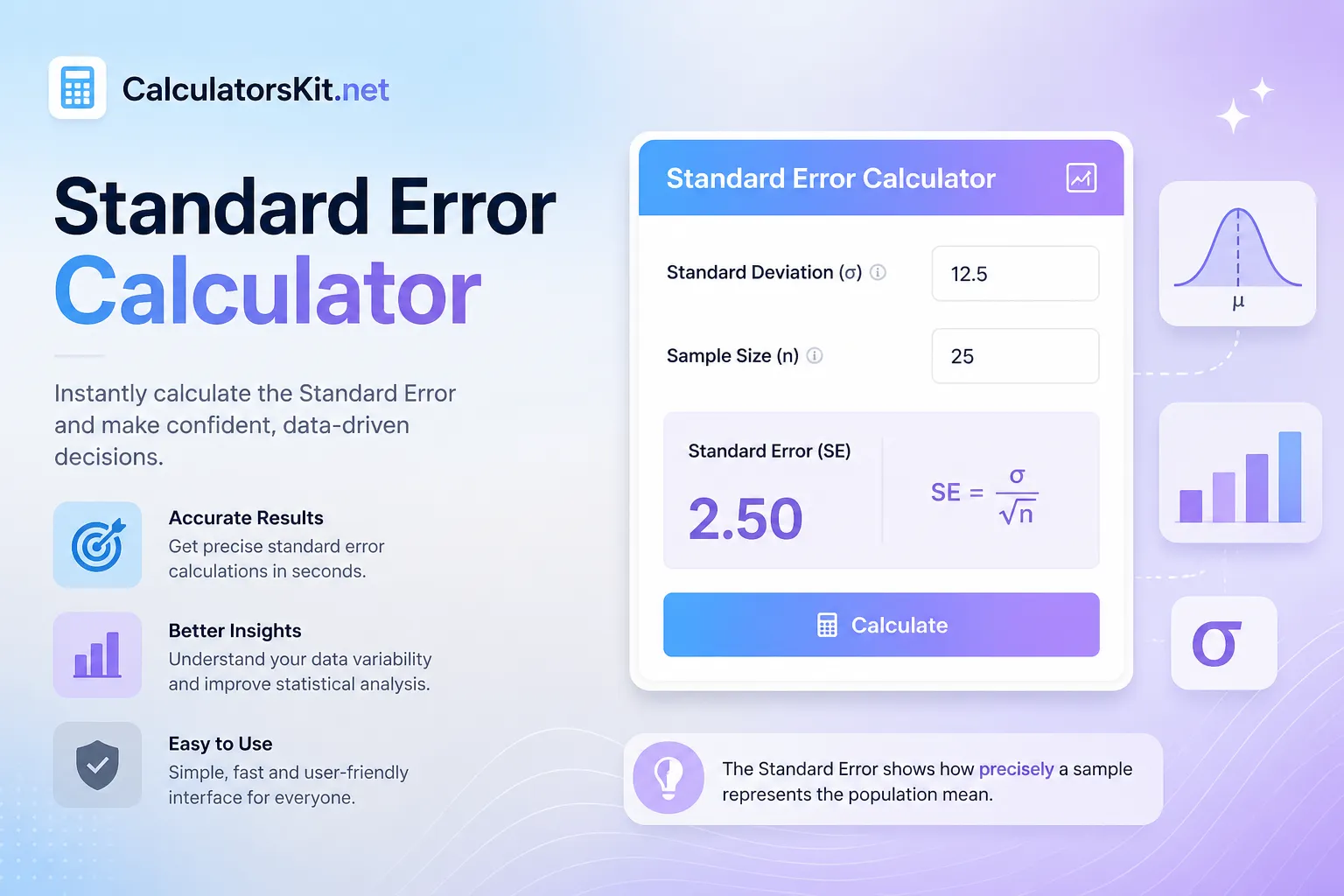
Calculate standard error quickly with formulas and examples. Learn SE for means, proportions, two samples, confidence intervals, Excel, and Casio.

Learn how to calculate a car loan payment using APR, interest, loan term, trade-in, and simple formulas. See examples and avoid costly mistakes.

Calculate productivity percentage instantly using billable and paid minutes. Learn lunch, concurrent therapy, targets, formulas, and billing units.