
Age Calculator by Date of Birth: Calculate Your Exact Age Online
Calculate your exact age online by date of birth. Find your age in years, months, and days, or calculate age as of any past or future date.
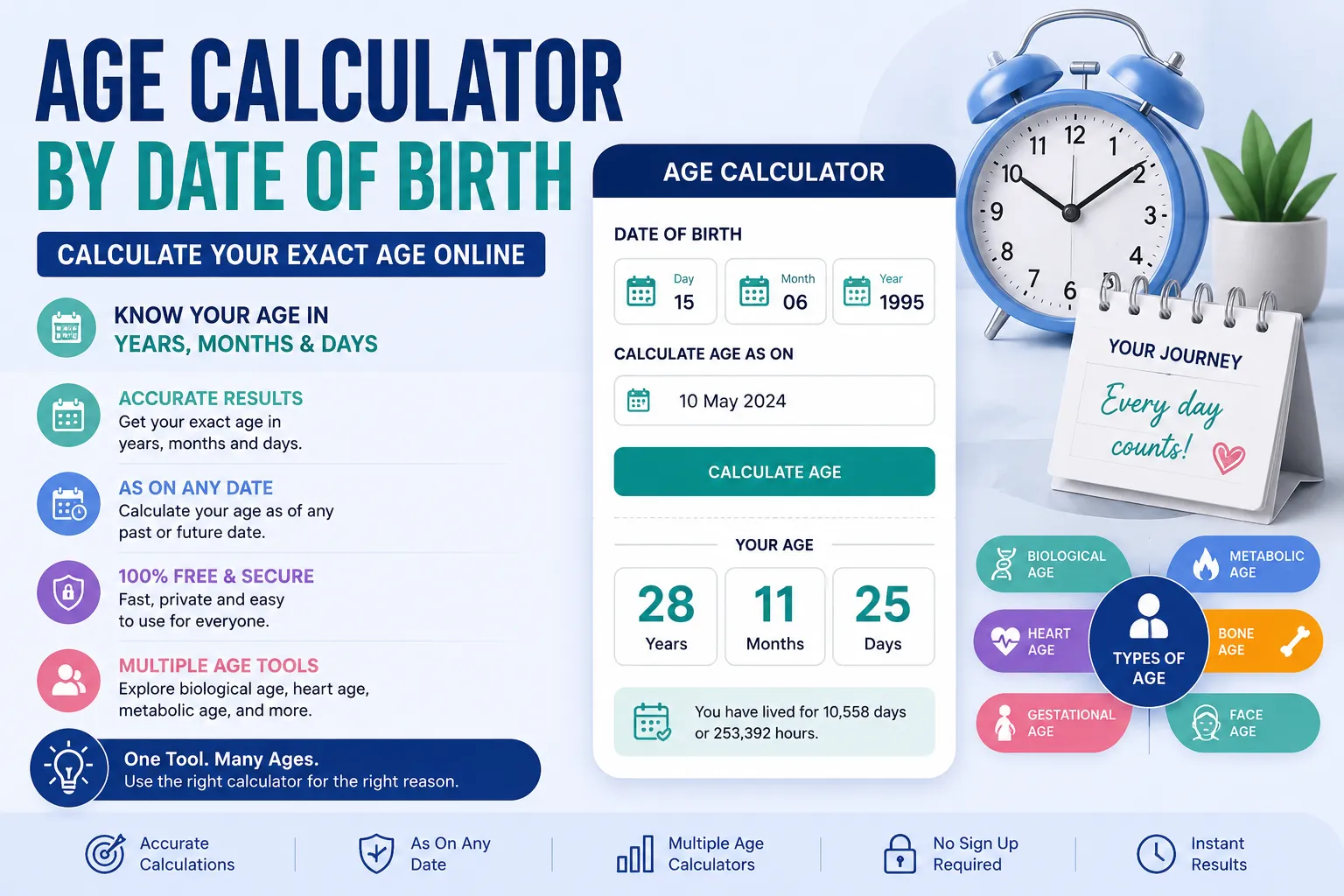
If you have ever typed your date of birth into a search bar just to double-check how old you are, you already know the problem: most free online age calculators give you a single number and nothing else. They do not tell you whether that number matches what a specific form, doctor, or fitness app actually needs: a plain chronological age, an age "as on" a particular date, or one of several health-related "ages" that measure something completely different from your birthday.
This guide fixes that. Below you will learn how a free online age calculator by date of birth works, how it differs from specialised tools like a bone age calculator, heart age calculator, biological age calculator, metabolic age calculator, gestational age calculator, and face age calculator, and how to pick the right one for your goal curiosity, a medical form, a fitness plan, or a legal document that needs your age calculated as on a specific date. After cross-checking dozens of these tools, one thing became clear quickly: "age calculator" is really an umbrella term for at least seven different calculations that people often confuse with each other, and getting the right one matters more than getting a fast one.
What an Online Age Calculator Actually Does
At its core, a basic age calculator takes two dates your date of birth and a reference date (usually today) and returns the difference in years, months, and days. That sounds simple, but the calculation has more edge cases than most people expect:
Leap years: someone born on 29 February only has a true birthday once every four years, and a good calculator handles this without breaking.
Month-length differences: going from 31 January to 28 February is not "one month" the same way 1 April to 1 May is; the day-count math changes.
Time zones: if you were born close to midnight and check your age from a different country, the calendar day can shift by one.
Calendar systems: some regions still need conversion between Gregorian and other calendars for official paperwork.
A tool that only subtracts years (this year minus birth year) will be wrong for roughly two-thirds of the calendar, accurate only after your birthday has passed. This is the biggest quality gap between a well-built calculator and a lazy one.
Free Online Age Calculator by Date of Birth: How the Math Works
Here is the logic a properly built calculator follows, step by step:
Take the birth date and the target date (today, or a custom date you enter).
Subtract the birth year from the target year to get a starting year count.
Check if the birth month and day have already occurred this year. If not, subtract one year.
Calculate remaining months by comparing birth month to target month, borrowing if the day count is negative.
Calculate remaining days using the actual number of days in the previous month, not a flat 30.
Many spreadsheet formulas get this wrong because they assume every month has 30 days, throwing the day count off by up to three days depending on the month.
If you just want the exact figure without doing the arithmetic yourself, you can run your own dates through this free online age calculator, which applies the leap-year and month-length logic above automatically and also gives you a custom "as on date" field for the scenario covered next.
Online Age Calculator As On Date: Why This Feature Matters More Than People Realise
Most people searching for an online age calculator as on date are not being curious; they are filling out a government form, a school admission application, a visa document, or a job eligibility check that requires their age on a specific past or future date, not today.
Common real situations where this comes up: government job applications with a maximum age limit "as on 1st January" of a given year, school or university admissions with an enrolment cut-off date, visa applications asking for age at the time of travel, pension eligibility calculated as on the retirement date, and legal contracts referencing age as on the date of signing.
If the form gives you two dates to work with instead of one (for example, a joining date and a cut-off date), a general-purpose date calculator can help you confirm the gap between them before you translate that into an age.
A mistake I see constantly: people calculate their age using today's date and submit that number on a form that actually needs their age as of a different date. Even one day off around a birthday can disqualify an application. Always change the "reference date" field to the exact date the form asks for; never assume today's date applies.
Beyond Your Birthday: The Other Kinds of Age People Search For
Chronological age (the number on your ID) is only one type of age. Health and identity science now recognise several other "ages" that describe how your body or a system is actually functioning, and they can be years apart from your real age. Below is a topical map of each one, what it measures, and where it is genuinely useful.
Age type | What it measures | Who typically needs it |
|---|---|---|
Chronological age | Time since birth, in years/months/days | Everyone forms, legal ID, milestones |
Biological age | How fast your cells and organs are ageing based on lifestyle markers | People tracking long-term health or longevity habits |
Metabolic age | How your resting metabolism compares to average people your age | People working on fitness, weight, or body composition goals |
Heart age | Cardiovascular risk compared to a healthy heart of the same demographic | Adults checking heart disease risk factors |
Bone age | Skeletal maturity from an X-ray, compared to standard growth charts | Paediatricians assessing a child's growth |
Gestational age | Weeks since the first day of the last menstrual period | Expecting parents and prenatal care providers |
Face age / "how old do I look" | Estimated age from facial features using image analysis | Casual users, skincare tracking, curiosity |
Biological Age Calculator: What It Actually Measures
A biological age calculator estimates how "old" your body behaves based on measurable inputs rather than your birth certificate. Free online versions typically ask for a mix of resting heart rate, blood pressure, sleep quality, smoking and alcohol habits, exercise frequency, diet quality, stress levels, and sometimes waist circumference.
The output is an estimate, not a diagnosis. The real value is the direction it moves over time. If your biological age drops after three months of better sleep and regular walking, that is a meaningful signal, even if the exact figure is approximate. Clinical-grade testing (blood biomarkers or DNA methylation) is far more accurate than any free web tool; the National Institutes of Health has a plain-language overview of how researchers build these "aging clocks" if you want the science behind the concept. Treat online versions as a motivational tracker, not a medical result; pairing one with a sleep calculator and a body fat calculator gives you a fuller picture of the habits actually driving the number.
Metabolic Age Calculator: A Fitness Tool, Not a Medical One
A metabolic age calculator compares your Basal Metabolic Rate (BMR), the calories your body burns at rest, to the average BMR of people your chronological age. A higher metabolic age usually means lower muscle mass or higher body fat than typical for your age group, since muscle burns more calories at rest than fat. You can check your own resting rate with a BMR calculator and compare it against a calorie calculator to see how your daily intake lines up with what your body actually burns.
Strength training that builds lean muscle raises resting calorie burn over weeks, not days.
Crash dieting can lower BMR as the body conserves energy; this can make metabolic age look worse, not better.
Hydration and time of day shift a single reading, so track trends across weeks, not one-off numbers.
Heart Age Calculator: Reading Your Cardiovascular Risk
A heart age calculator, a concept popularised by the CDC's Vital Signs heart age initiative, uses known cardiovascular risk factors such as blood pressure, cholesterol, smoking status, diabetes status, and family history to estimate your heart's "functional age" compared to your actual age. If it comes back higher than your real age, that is not a diagnosis; it is a risk flag, and the honest next step is a conversation with a doctor, not panic. These calculators use population-level statistics, so an individual result can be affected by factors the tool does not ask about, such as genetics. Tracking your resting and target zones with a heart rate zone calculator is a practical way to work on the modifiable factors between check-ups.
Bone Age Calculator: Why This One Requires a Professional
Unlike the tools above, a bone age calculator is not something you can meaningfully use on yourself. Bone age assessment requires an actual X-ray of the hand and wrist, which a radiologist or paediatrician compares against standardised atlases (commonly the Greulich-Pyle method) to see whether a child's skeletal maturity matches, lags, or is ahead of their chronological age. Free online versions are mostly educational, explaining reference ranges for parents, while the diagnostic-grade, AI-assisted tools used in clinics are for professional review, not consumer self-checks. Nemours KidsHealth has a clear, parent-facing explanation of how the X-ray exam itself works if a doctor mentioned your child's bone age; use it to understand the term before your appointment, not as a replacement for the X-ray reading.
Gestational Age Calculator: Weeks, Not Years
A gestational age calculator works differently from a standard birthday-based tool. Instead of counting years since birth, it counts weeks and days since the first day of the mother's last menstrual period (LMP), the standard doctors use worldwide to estimate a due date. Most calculators either add 280 days (40 weeks) to the LMP date, or, when the LMP is uncertain, work backward from an ultrasound measurement, which ACOG's clinical guidance considers the most accurate method in early pregnancy. Always confirm gestational age with a healthcare provider; use the online version for tracking between appointments, not for medical decisions.
Face Age Calculator and How Old Do I Look Tools
A face age calculator online uses image recognition to estimate age from a photo, analysing skin texture and facial proportions against a dataset of faces with known ages the technology behind most "how old do I look" quizzes. Lighting, angle, and image quality all shift the estimate, and accuracy drops for people outside the training data's typical age ranges. Treat these tools as entertainment, similar to a skincare progress photo, not a lab result.
How to Choose the Right Calculator for Your Situation
Filling out a form or legal document? Use a date-of-birth age calculator with an adjustable "as on date" field, not today's date by default.
Tracking overall health trends? Use a biological age calculator monthly, and log the inputs so you can see what changed.
Working on fitness or weight goals? Use a metabolic age calculator alongside body composition tracking, not on its own.
Concerned about heart disease risk? Use a heart age calculator as a conversation starter with your doctor, then get real readings.
Reviewing a child's growth? Treat bone age as a term to understand before an appointment, not a self-service tool.
Tracking a pregnancy? Use a gestational age calculator between appointments, and let ultrasound dating override LMP estimates when they differ.
Just curious how you look? Use a face age tool for fun, not as meaningful data.
Common Mistakes People Make With Age Calculators
Forgetting to change the reference date on forms that ask for age "as of" a specific date, not today.
Confusing metabolic age with biological age; they measure different things and often give different results.
Treating a face age result as an accurate biological measurement instead of an entertainment estimate.
Using LMP-only gestational age when a more accurate ultrasound date is available.
A Simple Framework: Four Questions Before You Trust Any Age Result
What exact date is this measured against? Today, a form's stated date, or a medical reference date.
Is this a legal number or a wellness estimate? Legal and medical documents need exact age; wellness tools give estimates only.
Does it match a second source? Cross-check important numbers before submitting them anywhere official.
Am I tracking a trend or one reading? Health-related age scores matter more compared over months than judged as a single result.
Conclusion
A free online age calculator looks like a one-purpose tool, but "age" is not one measurement; it is chronological, biological, metabolic, cardiovascular, skeletal, gestational, and even visual, depending on the question you are actually asking. Before trusting any result, confirm which type of age you need, which reference date applies, and whether the number is meant to be exact or an estimate. Used the right way, these calculators are genuinely useful for paperwork, for health tracking, and occasionally just for fun.
Frequently Asked Questions
Q: Is a free online age calculator accurate?
For chronological age, yes, a properly built calculator is exact, down to the day, since it is simple date arithmetic. Health-related calculators (biological, metabolic, heart) are estimates based on averages and self-reported inputs, so they are approximate by nature.
Q: What is the difference between age estimation and age calculation?
Calculation applies to known dates; you enter a birth date and get an exact result. Estimation applies when the exact birth date is unknown, such as guessing age from a photo or physical development. Estimation always carries a margin of error; calculation does not.
Q: Can I calculate my age as of a future date?
Yes. Any well-built calculator lets you set a custom reference date instead of defaulting to today, exactly what you need for future eligibility checks like retirement age or an upcoming deadline.
Related Articles
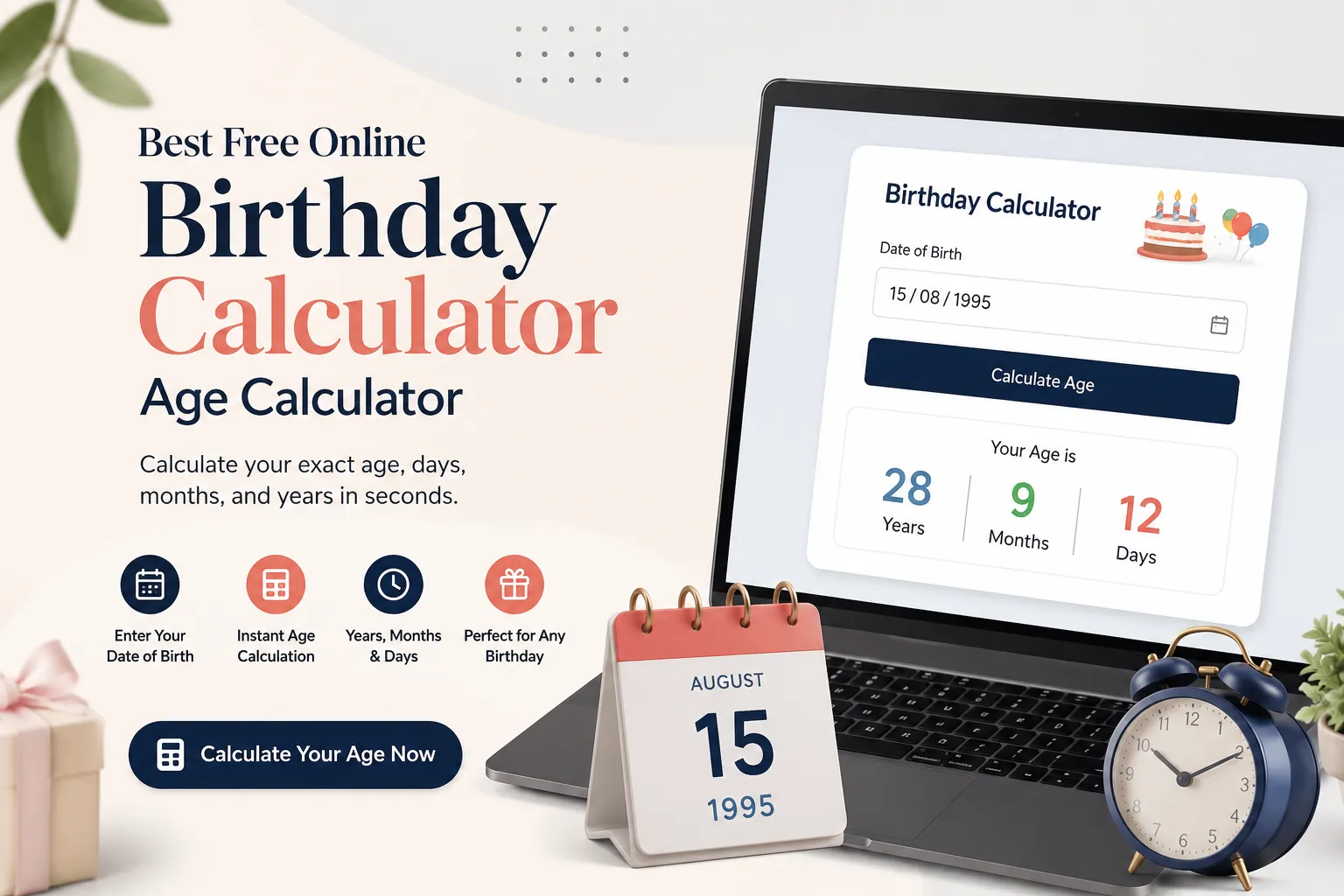
Calculate your exact age from your date of birth instantly. Free Age Calculator with years, months, days, birthday countdown, and leap year accuracy.
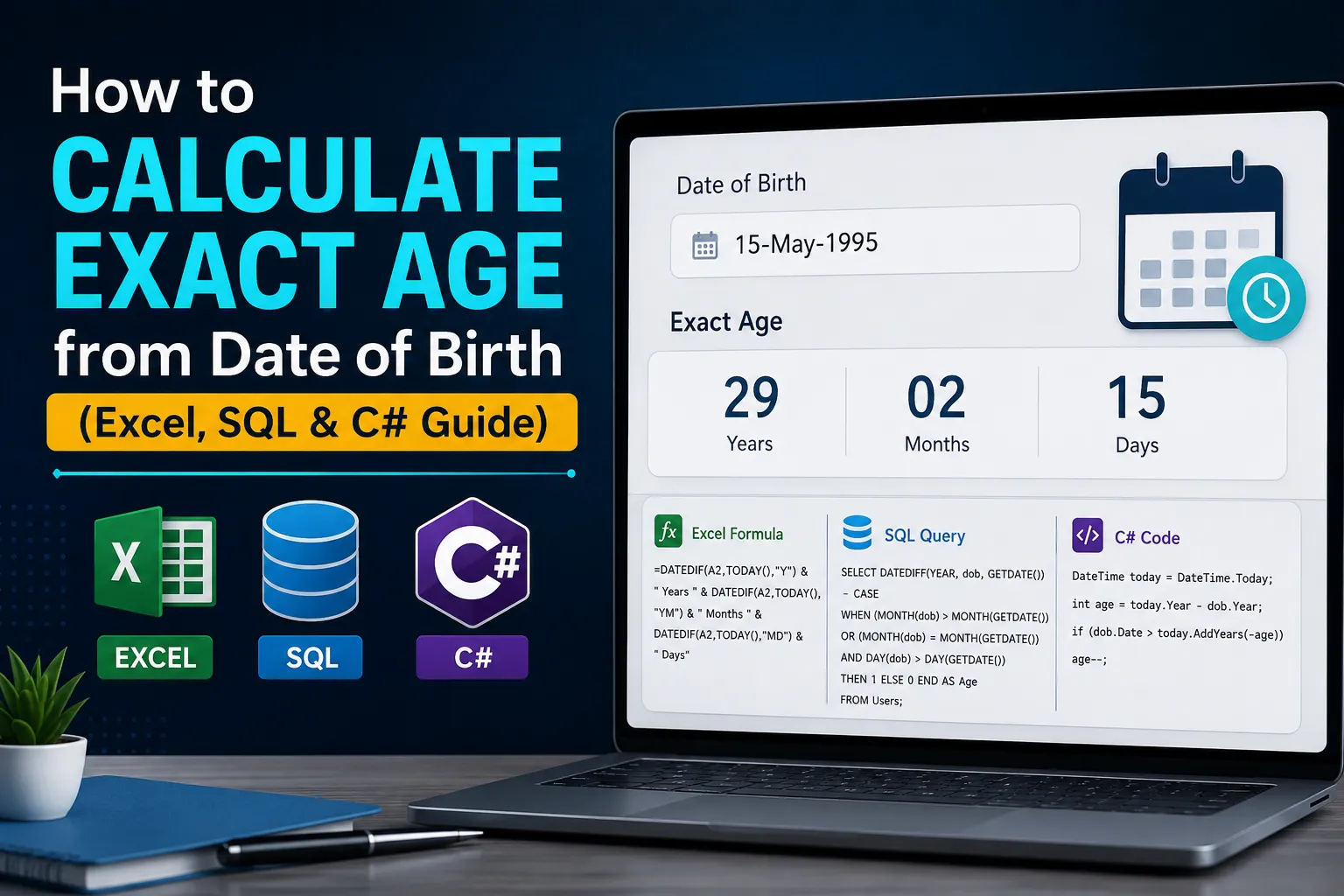
Learn how to calculate exact age from date of birth using Excel, SQL, and C#. Get accurate formulas, examples, avoid common mistakes, and calculate age for any date.
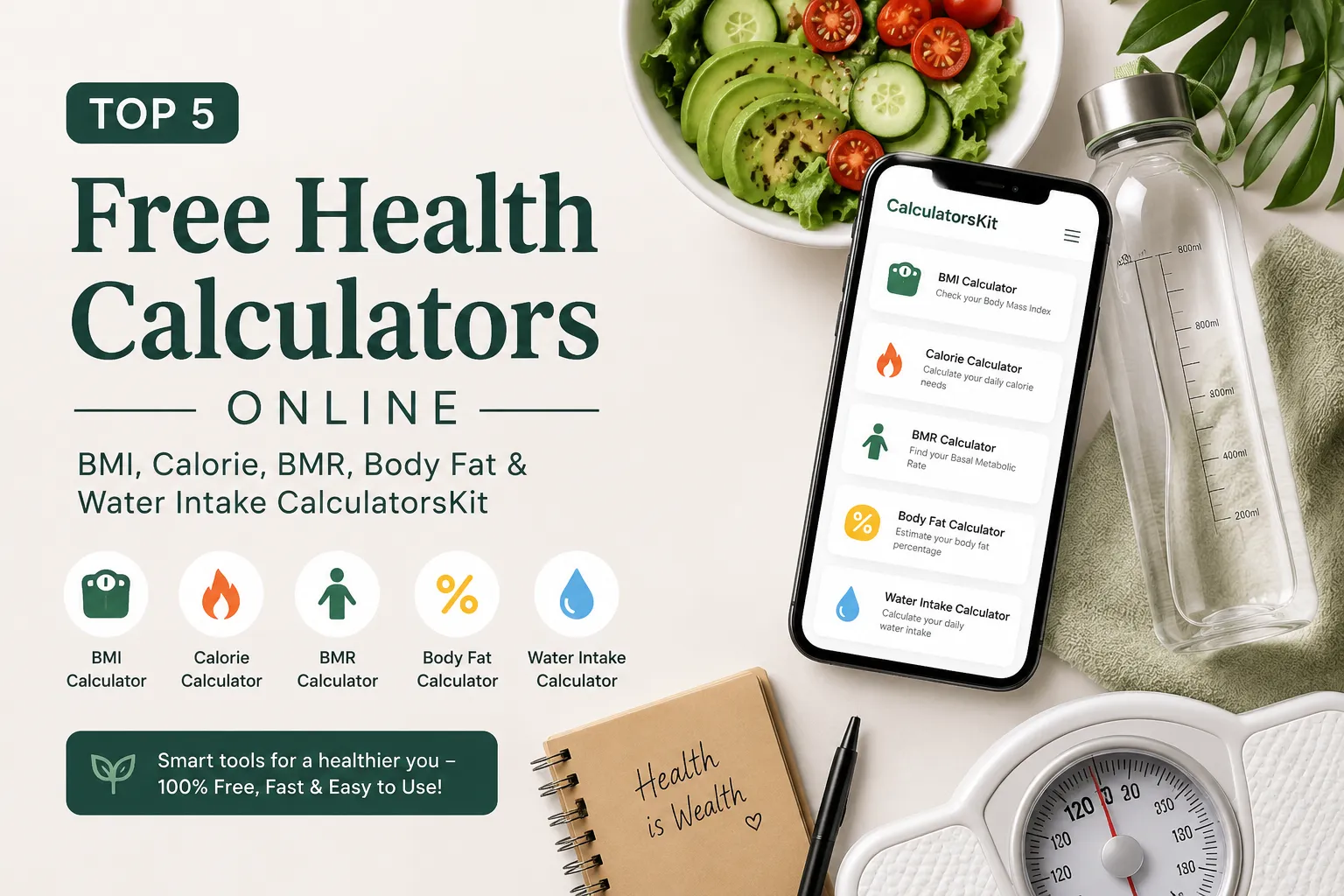
Use our free Health Calculator to calculate BMI, BMR, and TDEE instantly. Get accurate calorie needs, healthy weight insights, and fitness results.
Calculate standard error quickly with formulas and examples. Learn SE for means, proportions, two samples, confidence intervals, Excel, and Casio.