
Advanced Percentage Calculator: JEE, Tax, Body Fat & More
Use an advanced percentage calculator for reverse percentages, percentage change, JEE marks, advance tax, and body fat. Learn the formulas with easy examples.
Percentages sit quietly behind almost every decision you make with numbers, from checking exam marks to estimating a tax bill to tracking body composition. Yet most free percentage calculators online only handle the basic formula and stop there. An advanced percentage calculator goes further. It handles multi-step problems, reverse calculations, percentage change, and specialized formats used in exams, taxation, and fitness tracking, all inside one tool. This guide breaks down exactly what an advanced percentage calculator should do, how to use one correctly for different real situations including JEE marks, advance tax estimates, and body fat percentage, and how to avoid the calculation mistakes that trip up even careful students and professionals.
What Makes a Percentage Calculator Truly Advanced
Most basic calculators answer one question: what is X percent of Y? That formula is useful, but it covers a small slice of what people actually need. An advanced percentage calculator adds several capabilities at once:
Reverse percentage solving, finding the original number when you know the result and the percentage
Percentage increase and decrease across two values
Percentage difference between two independent quantities
Compound percentage stacking, such as applying two discounts or two tax slabs in sequence
Domain-specific modes, such as exam score conversion, tax bracket estimation, or body composition formulas
The difference is not cosmetic. A calculator without reverse solving cannot tell you your original salary if you only know your after-tax income and the tax rate. A calculator without compound stacking will silently give you the wrong number when two percentages apply one after another, which is exactly what happens with tax slabs and layered discounts.
Core Percentage Formulas Every Calculator Should Handle
Basic Percentage
The standard formula is Part divided by Whole, multiplied by 100. If you scored 450 out of 500 marks, your percentage is 450 divided by 500, multiplied by 100, which equals 90 percent.
If you would rather skip the manual math, this free online percentage calculator applies the same formula instantly and also handles the reverse and percentage change modes covered below.
Percentage Increase or Decrease
Subtract the old value from the new value, divide by the old value, then multiply by 100. A salary that rises from 40000 to 46000 represents a 15 percent increase. This formula is the one people get wrong most often because they divide by the new value instead of the old one.
Reverse Percentage
If 20 percent of a number equals 80, the original number is 80 divided by 0.20, which equals 400. This calculation matters when you know a discounted price and the discount rate, and you need the original price.
Percentage Points Versus Percentage Change
An interest rate moving from 5 percent to 7 percent is a rise of 2 percentage points, but a percentage change of 40 percent. Mixing these two ideas is a common error in financial reporting, and a genuinely advanced calculator labels the two results separately rather than collapsing them into a single number.
How to Use an Advanced Percentage Calculator
Identify what you actually know: is it the part, the whole, or the percentage itself? You can only solve for the missing piece.
Choose the correct mode, since basic percentage, increase or decrease, reverse percentage, and compound stacking are different calculations, not variations of the same one.
Enter values without rounding early. Round only the final answer; otherwise, small errors compound across multi-step problems.
Compare the final answer with a quick estimate to make sure the result seems reasonable. If a calculator tells you 45 percent of 900 is 810, a quick mental check, half of 900 is 450, so 45 percent should land close to that, flags the error immediately.
Save or note the formula used, not just the number, if you will need to explain the calculation later, such as in an exam answer sheet or a tax filing.
JEE Advanced Percentage Calculator: Converting Marks to Percentage the Right Way
Students preparing for JEE Advanced often search for a percentage calculator because the exam uses a marking scheme with negative marks for wrong answers, which makes manual calculation error-prone.
Here is the practical method:
Add correct answer marks first, keeping track of full marks and partial marks separately if the paper allows partial marking.
Subtract negative marks for incorrect responses at the rate specified in that year's official marking scheme, since JEE Advanced marking rules have changed across different years and even across question types within the same paper.
Divide the net score by the total maximum marks for that year's paper, not by an assumed round number, since JEE Advanced total marks vary by year.
Multiply by 100 to get the raw percentage.
A common mistake students make is confusing percentage score with percentile rank. Your percentage tells you what share of total marks you earned. Your percentile tells you how you rank against every other candidate that year. A 60 percent score can correspond to a very different percentile depending on how difficult that year's paper was and how the rest of the candidate pool performed. An advanced percentage calculator that only outputs a raw percentage is not enough for admission planning. Pair the percentage result with the official percentile or rank predictor released by the exam authority before concluding college eligibility.
Always confirm the year's exact marking scheme and total marks on the official JEE Advanced website before finalizing a percentage calculation, since the rules are set fresh for each exam cycle. Once you have your final percentage, a GPA and grade calculator is useful for tracking how that score fits alongside your overall academic record.
Advance Tax Percentage Calculator: Estimating Your Tax Liability Ahead of Time
Advance tax is income tax paid in installments during the financial year rather than as one lump sum after the year ends. Getting the percentage math right here avoids both underpayment penalties and overpayment of cash you could have used elsewhere.
The practical steps:
Estimate total expected income for the financial year, including salary, business income, capital gains, and any other taxable source.
Apply the correct slab percentages for that income level under the tax regime you have chosen, since slab rates differ between the old and new regimes and change with government budget updates.
Calculate tax due on the full estimated income, then subtract tax already deducted at source, because advance tax applies only to the remaining liability.
Split the remaining amount according to the official installment percentages and due dates set for that financial year, rather than dividing it evenly by four, since the required percentage at each due date is usually not equal across installments.
The biggest mistake taxpayers make is estimating income too conservatively early in the year, then facing a large jump in the final installment when actual income turns out higher, which can trigger interest charges for underpayment. A calculator that lets you revise your income estimate each quarter and recompute the remaining percentage owed is genuinely more useful than one that only calculates a single static figure at the start of the year. Because tax slab percentages and installment schedules change with each budget cycle, always confirm current rates against the official tax department website before filing, rather than relying on a calculator's built-in defaults from a previous year.
The official advance tax due date and installment schedule is published by the Income Tax Department and should be treated as the final word over any third-party estimate. For related planning, this collection of finance and budgeting calculators can help you model income and expenses alongside the tax figure.
Advanced Body Fat Percentage Calculator: Measuring Health Beyond the Scale
Body weight alone does not tell you much about health, because two people at the same weight can carry very different amounts of muscle versus fat. Body fat percentage estimates what portion of total body weight is fat tissue.
The US Navy method, which uses neck, waist, and, for women, hip measurements alongside height, is reasonably accurate for a home measurement without special equipment.
The body mass index-based estimate adjusts a body mass index figure using age and gender, and works as a rough estimate but is less accurate for muscular individuals.
Skinfold measurements require calipers and practice, but tend to be more precise when done consistently by the same person.
A practical use case: two people both weigh 80 kilograms. One has a body fat percentage near 15 percent because they carry significant muscle mass. The other has a body fat percentage near 28 percent with much less muscle. Weight alone hides this difference completely, while body fat percentage reveals it immediately. This is exactly why athletes, coaches, and anyone tracking a fitness goal rely on body fat percentage rather than the scale number alone.
For consistent tracking, measure at the same time of day, under similar hydration conditions, and with the same method each time. Switching between the Navy method and a skinfold estimate mid-program will produce numbers that are not directly comparable, even if both methods are individually reasonable.
The CDC's guidance on body mass index explains why BMI alone cannot distinguish fat from muscle, which is exactly the gap a body fat percentage estimate is meant to fill. You can run the Navy method calculation yourself with this body fat percentage calculator to get a quick, consistent estimate.
What Makes a Calculator the Most Advanced Calculator Online
People searching for the most advanced calculator online are usually looking for one tool that replaces several single-purpose calculators. The features that genuinely earn that label:
Multiple calculation modes in one interface, covering basic percentage, reverse percentage, percentage change, and domain-specific formats like exam scoring, tax, and body composition.
A clear display of the formula used alongside the answer, so the result is verifiable rather than a black box.
Support for decimal precision without rounding errors compounding across multi-step calculations.
Instant recalculation as inputs change, with no lag or layout shift while typing, since a slow or jumpy interface undermines trust even when the math is correct.
Mobile-friendly design, since a large share of quick percentage lookups happen on a phone between other tasks.
Common Mistakes People Make With Percentage Calculations
Dividing by the wrong base number, especially in percentage change problems, where the old value is the correct denominator, not the new value.
Treating percentage points and percentage change as interchangeable, which distorts financial and statistical comparisons.
Rounding too early in a multi-step problem, which lets small errors accumulate into a noticeably wrong final answer.
Assuming a generic percentage calculator can handle a specialized case like JEE negative marking or layered tax slabs, when those situations need their specific rules applied before the basic formula is even used.
Comparing body fat percentage results across different measurement methods as if they were directly comparable.
Conclusion
An advanced percentage calculator earns that description by handling the full range of situations people actually encounter, not just the textbook formula. Whether you are converting JEE Advanced marks, estimating an advance tax installment, tracking body fat percentage over a training program, or simply looking for the most advanced calculator online to replace several separate tools, the same principle applies. Know exactly what you are solving for, use the correct formula variant for that situation, and verify the result before you rely on it for a decision that matters.
If this guide covered the calculation you needed, the full library of free online calculators covers math, finance, education, and health tools built on the same verified formulas.
Frequently Asked Questions
Q: What is the fastest way to calculate a percentage without a calculator?
Multiply the whole number by the percentage expressed as a decimal. For 20 percent of 150, multiply 150 by 0.20 to get 30.
Q: Is percentage the same as percentile in JEE Advanced results?
No. Percentage reflects the share of total marks earned, while percentile reflects your standing relative to other candidates in that year's exam.
Q: How often do advance tax slab percentages change?
Rates can change with each government budget cycle, so always verify current figures against the official tax department source before filing.
Q: Which body fat percentage measurement method is most accurate at home?
The US Navy method, which uses neck, waist, and hip measurements, offers a reasonable balance of accuracy and convenience without special equipment.
Related Articles
Learn how to calculate percentages with easy formulas, step-by-step examples, discounts, grades, percentage increase, decrease, and Excel formulas.

Convert GPA, CGPA, and Percentage instantly with our free calculator. Use accurate formulas, compare grading systems, and get fast results.

See how long your savings can last in retirement. Calculate withdrawals, inflation, taxes, and returns with real $750K and $2M examples.
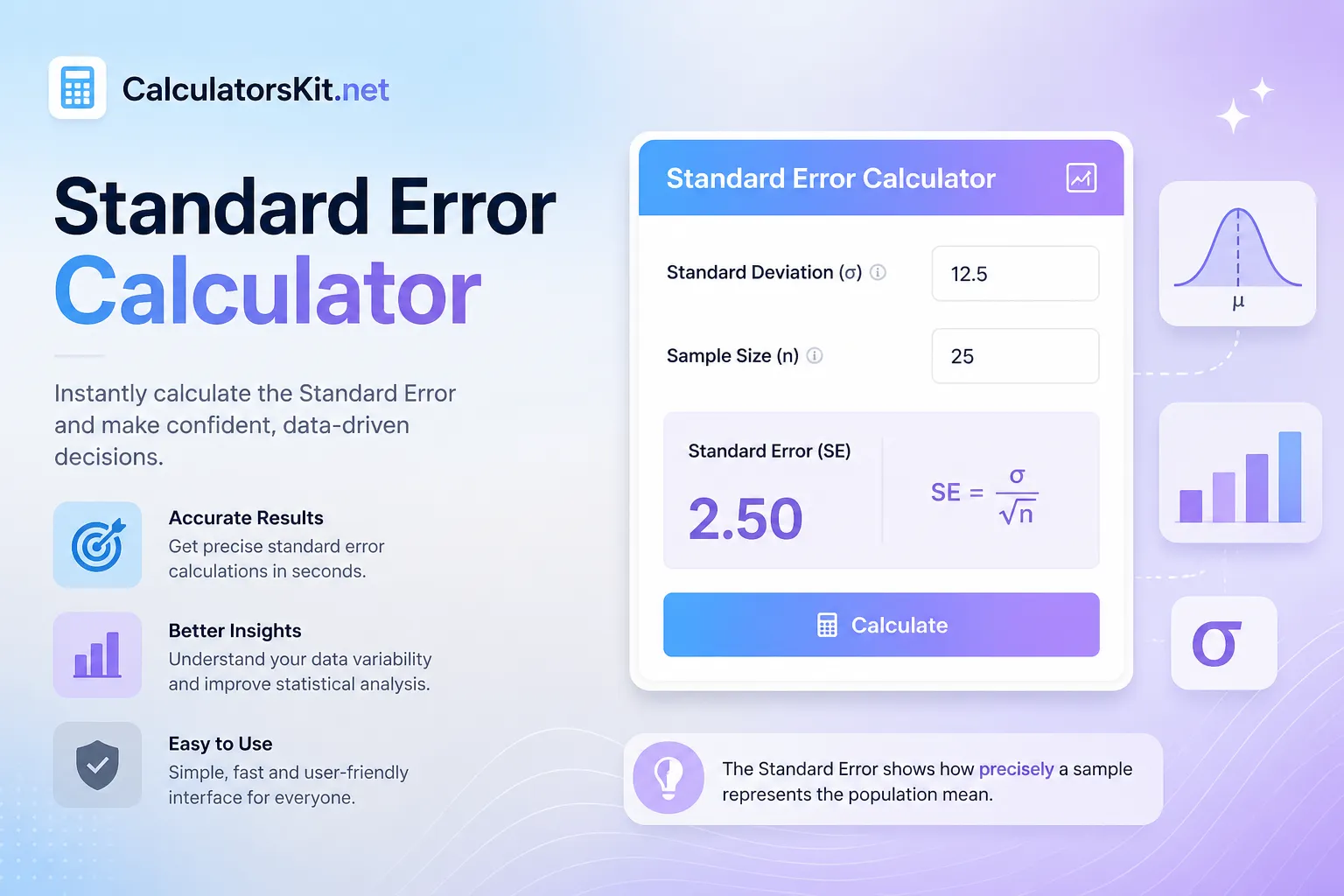
Calculate standard error quickly with formulas and examples. Learn SE for means, proportions, two samples, confidence intervals, Excel, and Casio.