
Free GPA, CGPA & Percentage Calculator (Accurate Converter)
Convert GPA, CGPA, and Percentage instantly with our free calculator. Use accurate formulas, compare grading systems, and get fast results.
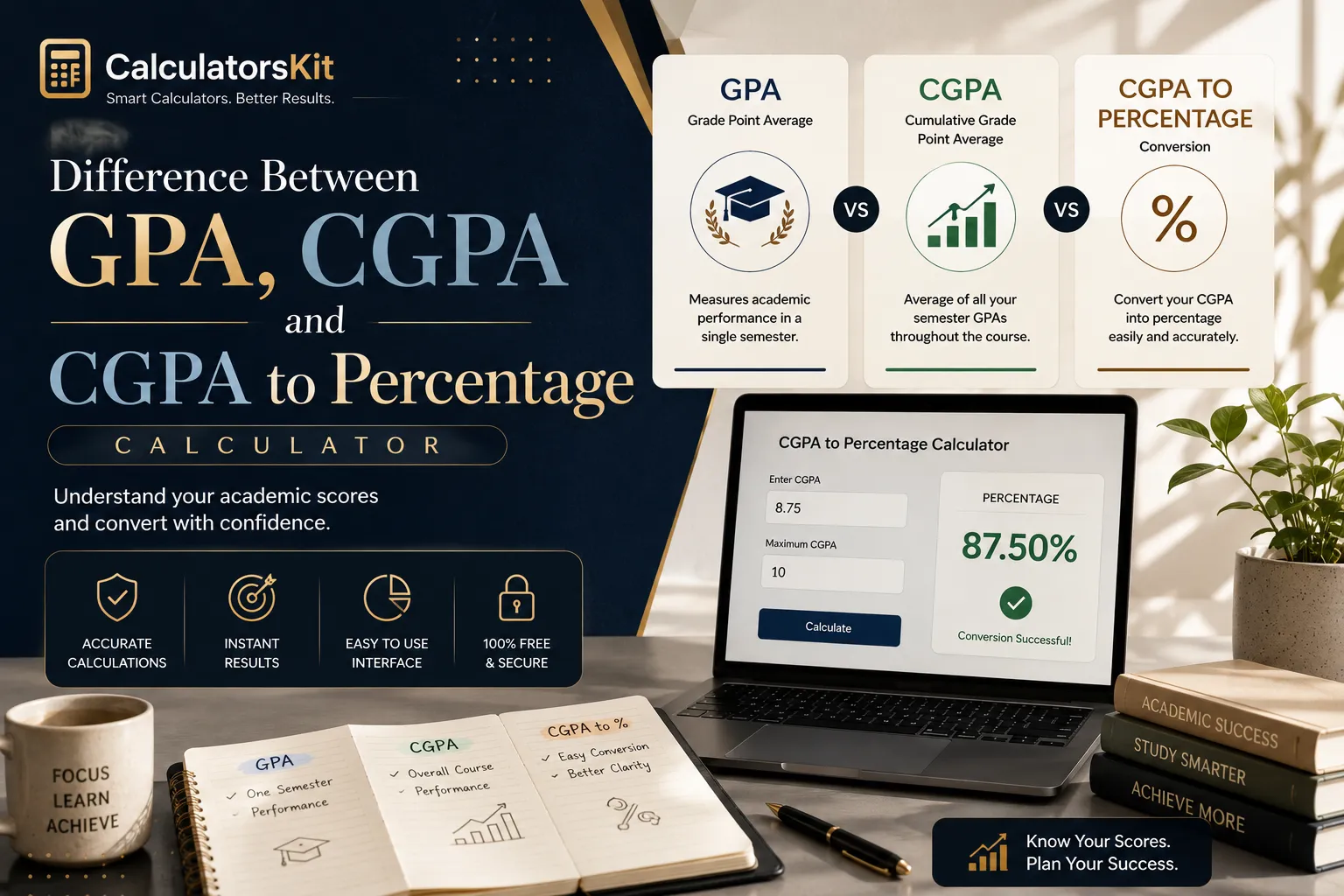
Every admission form, scholarship application, and job portal seems to ask for a different number. One wants your GPA. Another wants CGPA. A third insists on percentage. If you have ever stared at a form wondering which number to type in, you are not alone; this is one of the most common points of confusion for students moving between school boards, universities, and countries.
This guide breaks down GPA, CGPA, and percentage in plain language, shows you exactly how each one is calculated, and gives you a working CGPA to percentage calculator formula for the grading systems most students actually use. No jargon, no filler, just the numbers and steps you need.
What Is GPA?
GPA stands for Grade Point Average. It measures how well you performed in a single term, semester, or year, not your entire academic career.
Most institutions use one of two common scales:
4.0 scale: used widely in the US, Canada, and many international universities. A 4.0 usually means straight A's.
10.0 scale: used in most Indian universities and engineering colleges. A 10.0 means top grades across every subject.
Your GPA changes every semester based on that semester's performance. If you scored well this term but poorly last term, your GPA reflects only the current term; it resets with each grading period.
Example: If you took 5 subjects in a semester and earned grade points of 8, 9, 7, 8, and 9 (on a 10-point scale), your GPA for that semester is the average of these five numbers, usually weighted by credit hours.
If you would rather skip the manual math, you can enter your subject-wise grades into this GPA calculator and get your semester GPA instantly.
What Is CGPA?
CGPA stands for Cumulative Grade Point Average. Unlike GPA, it does not reset; it is the running average of all your GPAs from every semester or year completed so far.
Think of it this way: GPA is a single photograph; CGPA is the full photo album. Your CGPA after your final semester represents your entire academic record, not just your best or worst term.
Example: If your GPA was 8.2 in semester 1, 7.8 in semester 2, 8.5 in semester 3, and 8.0 in semester 4, your CGPA at the end of semester 4 is the weighted average of all four semester GPAs, not just the latest one.
This is why a single bad semester rarely destroys your CGPA, but it does pull it down slightly, and why one excellent final year cannot fully erase a weak first year.
GPA vs CGPA vs Percentage: Key Differences
Factor | GPA | CGPA | Percentage |
|---|---|---|---|
Time period covered | One semester or term | All semesters/years combined | Usually a full year or full course |
Resets each term? | Yes | No, it accumulates | No |
Common scale | 4.0 or 10.0 | 4.0 or 10.0 | 0–100 |
Used mainly by | US colleges, term report cards | Indian universities, engineering/medical colleges | School boards (CBSE, state boards), older university systems |
Best for showing | Recent performance/improvement | Overall academic consistency | Absolute score comparison |
The practical takeaway: GPA tells a recruiter or admissions officer "how did you do recently," while CGPA tells them "how have you done overall." Percentage is simply a different unit for expressing the same underlying performance, and it is what many Indian school boards and older-style university systems still use on official transcripts.
How GPA Is Calculated
List each subject's credit hours. Heavier subjects (like core engineering papers) often carry more credits than electives.
Assign grade points to each subject based on the marks or letter grade you received (e.g., A = 9, B+ = 8, and so on, depending on your institution's grading chart).
Multiply credit hours by grade points for each subject.
Add up all these products, then divide by the total credit hours for the semester.
Worked example:
Subject | Credits | Grade Point | Credits × Grade Point |
|---|---|---|---|
Maths | 4 | 9 | 36 |
Physics | 3 | 8 | 24 |
Chemistry | 3 | 8 | 24 |
English | 2 | 9 | 18 |
Lab | 2 | 10 | 20 |
Total | 14 | — | 122 |
GPA = 122 ÷ 14 = 8.71
How CGPA Is Calculated
CGPA follows the same logic, just extended across semesters:
Calculate the GPA for every completed semester using the method above.
Note the total credits attempted in each semester.
Multiply each semester's GPA by that semester's total credits.
Add these values across all semesters, then divide by the total credits across all semesters combined.
This is a weighted average, not a simple average. A semester with more credit hours pulls the CGPA slightly more than a lighter semester.
Worked example (4 semesters, 14 credits each for simplicity):
Semester 1 GPA: 8.71 → 8.71 × 14 = 122.0
Semester 2 GPA: 7.90 → 7.90 × 14 = 110.6
Semester 3 GPA: 8.50 → 8.50 × 14 = 119.0
Semester 4 GPA: 8.10 → 8.10 × 14 = 113.4
Total = 465.0, Total credits = 56
CGPA = 465.0 ÷ 56 = 8.30
Doing this across four or eight semesters by hand gets tedious and error-prone. This CGPA calculator does the weighted averaging for you; just enter each semester's GPA and credits.
CGPA to Percentage Calculator: The Formula That Actually Applies to You
This is where most confusion happens, because there is no single universal formula. Each board or university sets its own multiplier, and using the wrong one can make your percentage look lower or higher than it really is. Here are the formulas actually used by major systems:
Prefer not to calculate by hand? This CGPA to percentage calculator applies the correct formula for your board or university and gives you the exact figure in one step.
CBSE (Class 10 & 12): Percentage = CGPA × 9.5
Anna University: Percentage = CGPA × 10
VTU (Visvesvaraya Technological University): Percentage = (CGPA − 0.75) × 10
Most other 10-point scale universities: Percentage = CGPA × 9.5 (a common general approximation, but always confirm with your institution)
4.0 GPA scale (US-style): Percentage ≈ (GPA ÷ 4) × 100. This is only an approximation since US grading does not map cleanly to percentage
Step-by-step example using CBSE's formula:
If your CGPA is 8.30:
Take the CGPA: 8.30
Multiply by 9.5: 8.30 × 9.5 = 78.85
Your equivalent percentage is 78.85%
Same CGPA under VTU's formula:
Subtract 0.75: 8.30 − 0.75 = 7.55
Multiply by 10: 7.55 × 10 = 75.5
Your equivalent percentage is 75.5%
Notice how the same CGPA of 8.30 produces two different percentages depending on the formula. This single fact causes more application errors than anything else; always check which formula your specific board or university officially uses before you write a number on any form.
Note: CBSE's ×9.5 formula was designed for its Class 10 grading circular and no longer applies to fresh Class 10 marksheets, since CBSE moved back to direct percentage reporting from 2017 onward; see the official CBSE grading system page for the current policy. University-level CGPA, on the other hand, still follows the 10-point scale recommended in the UGC's Choice Based Credit System guidelines, which is why colleges and universities use their own separate conversion formula rather than CBSE's.
Common Mistakes Students Make
Using the CBSE multiplier for a university CGPA: The 9.5 multiplier is specific to CBSE. Applying it to an engineering college CGPA that actually uses a ×10 or VTU-style formula gives an incorrect percentage.
Confusing semester GPA with final CGPA on a resume: Recruiters expect your overall CGPA, not your best semester's GPA. Listing your highest single-semester GPA as your overall score is misleading and can be flagged during verification.
Rounding too early: Rounding your CGPA to one decimal before converting can shift your final percentage by a full point. Always convert using the full CGPA value, then round the final percentage.
Assuming a 10-point CGPA equals the same number out of 100: An 8.3 CGPA is not "83%" unless your institution's formula says so. This is one of the most repeated errors among first-year students.
Not checking updated formulas: Some universities revise their conversion formulas every few years. A formula you found in an old forum post might no longer be the official one; always verify on your university's current examination handbook or official website.
Mixing GPA scales when applying abroad: A 3.7 out of 4.0 is not the same academic level as a 7.4 out of 10, even though the numbers look similar. Use an official scale conversion rather than assuming a linear match.
Which One Actually Matters: GPA, CGPA, or Percentage?
For semester-wise scholarships or term awards: GPA matters most, since these are usually awarded based on a single term's performance.
For final degree certificates, job applications, and higher education admissions: CGPA matters most, because it reflects your consistency across your entire course.
For school-level admissions (Class 11 entry, some state college admissions): Percentage still matters most, since many boards and colleges continue to ask for percentage on official forms.
For studying abroad: Universities usually want your CGPA plus a country-specific conversion, not a raw percentage. Many international applications ask you to attach an official transcript so the receiving institution can convert it using their own equivalence chart.
The safest approach is to keep all three numbers ready: your latest GPA, your final CGPA, and the percentage equivalent using your institution's official formula, since different forms will ask for different ones without warning.
Conclusion
GPA, CGPA, and percentage are not competing systems; they are three different lenses on the same academic performance, each used at a different stage of your education. Once you know which number applies to which situation, and which formula your own institution uses, converting between them takes less than a minute. Keep your official transcript handy, double-check the multiplier before you submit any form, and you will avoid the single most common mistake students make: submitting the wrong number to the right form.
Frequently Asked Questions
Q: Is CGPA the same as GPA?
No. GPA covers one semester or term. CGPA is the cumulative average of all your GPAs across every completed semester or year.
Q: How do I convert CGPA to percentage manually?
Multiply your CGPA by your institution's official conversion factor. For CBSE, multiply by 9.5. For many universities, multiply by 10. Always confirm the exact factor with your own institution, since it varies.
Q: Is 8.5 CGPA a good score?
On a 10-point scale, 8.5 generally converts to roughly 80–85%, depending on the formula used, which is considered a strong, above-average academic record in most systems.
Q: Why do different universities use different CGPA to percentage formulas?
Because each institution designs its own grading chart and credit-weighting system, the relationship between grade points and raw marks is not identical across institutions, so no single formula applies everywhere.
Q: Can I use percentage instead of CGPA when applying for jobs?
Yes, if your institution provides an official percentage equivalent on your transcript. Many recruiters accept either, but if a specific percentage is asked and your certificate only shows CGPA, convert it using your university's official formula and mention the formula source if requested.
Related Articles

See how long your savings can last in retirement. Calculate withdrawals, inflation, taxes, and returns with real $750K and $2M examples.

Find the best scientific calculator online for free. Compare Desmos, GeoGebra, Casio, and TI-84 options for homework, exams, engineering, and everyday math.

Use our free cubic feet calculator to calculate box, tank, wood, soil, and storage volume accurately from feet, inches, or cm.
Use an advanced percentage calculator for reverse percentages, percentage change, JEE marks, advance tax, and body fat. Learn the formulas with easy examples.