
USPS Mail Delivery Time Calculator: Calculate Delivery Dates by ZIP Code
Calculate USPS mail delivery time by ZIP code. Compare First-Class, Ground Advantage, Priority Mail, and Express delivery estimates easily.
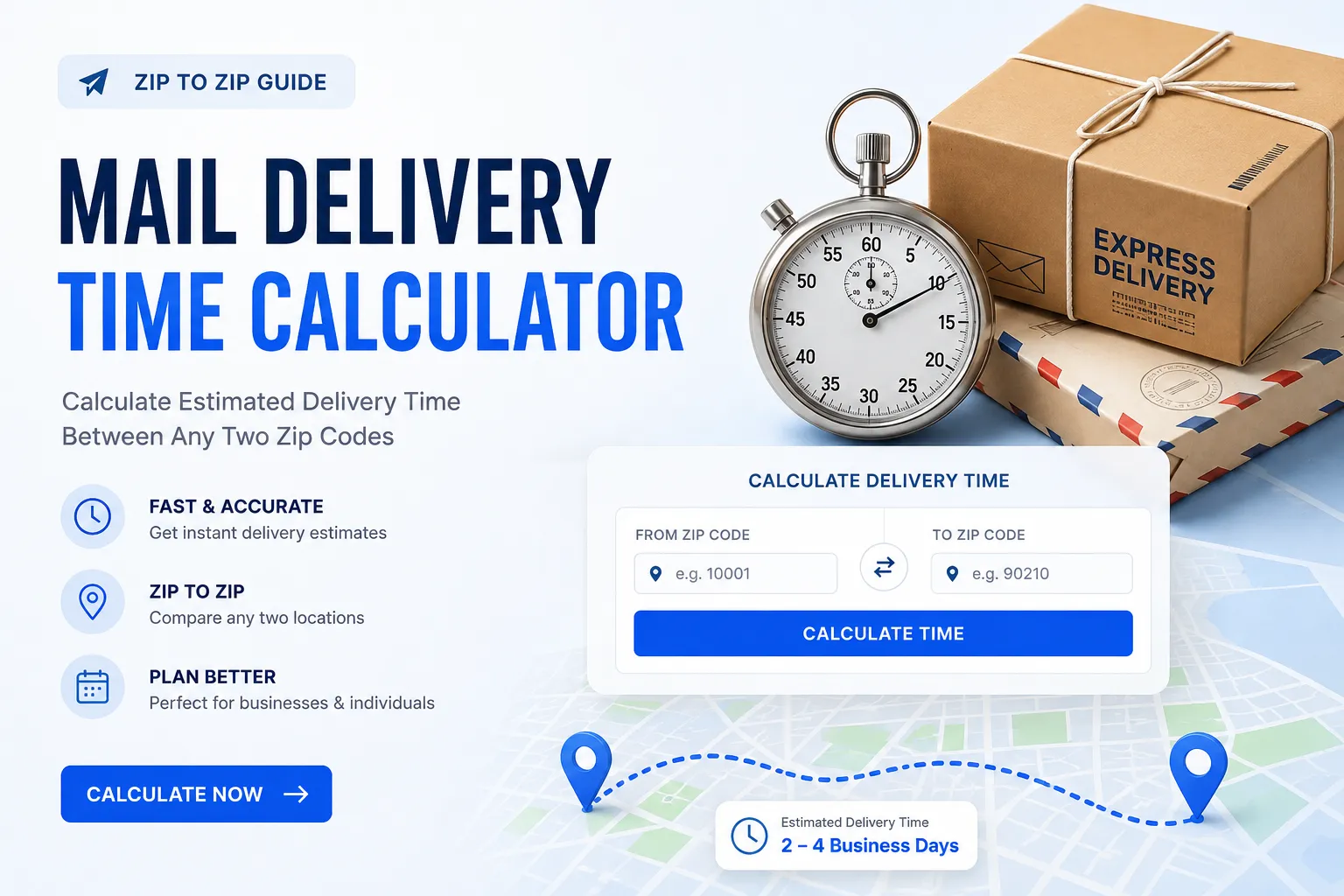
If you have ever typed "mail delivery time calculator" into Google right before a deadline, you know the problem: the answer usually depends on more than the calculator lets you enter. A mail delivery time calculator is only useful once you understand what it actually measures because USPS does not promise a single number. It publishes a service standard, a target range built from ZIP-to-ZIP transportation zones, not a guarantee stamped on your envelope.
This guide breaks down how a USPS delivery time calculator works ZIP code to ZIP code, how to read it for First Class, Ground Advantage, Priority Mail, and international mail, where to find the real calculator on USPS.com, and the mistakes that make people's estimates wrong. By the end, you can calculate a realistic delivery date yourself with or without a tool.
What a Mail Delivery Time Calculator Actually Measures
A mail transit time calculator does not track your specific envelope. It cannot, because most mail classes below Priority Mail are not individually scanned at every stop. Instead, the calculator pulls from a database of historical service standards that USPS assigns to every origin-destination ZIP pair. Think of it less like a live GPS tracker and more like a flight-time estimate: it tells you what is normal for that route, not what will happen to your exact piece of mail.
This distinction matters because it explains three things people usually misunderstand about a postal delivery time calculator:
It gives a range, not a guaranteed date: only Priority Mail Express carries a formal money-back delivery guarantee.
It counts business days: so weekends and federal holidays do not add to the count but do delay the arrival date.
The clock starts at acceptance scan (when USPS physically takes the mail): not the moment you drop it in a blue collection box or hand it to a clerk after the day's last pickup.
How the USPS Delivery Time Calculator Works ZIP to ZIP
A USPS delivery time calculator by ZIP code compares the origin ZIP and the destination ZIP against USPS's internal network map, which is organized into transportation zones numbered roughly 1 through 8. Zone 1–2 covers local and regional routes; Zone 8 covers coast-to-coast or the farthest practical distance from the origin. The wider the zone gap, the more processing hubs your mail has to pass through, and the longer the standard window becomes.
Here is the part most tools skip explaining: zone distance is not simply "miles apart." A package moving between two ZIP codes 40 miles apart but served by different regional distribution centers can sometimes take longer than a package moving 300 miles along a direct sorting corridor. This is why plugging two ZIP codes into a calculator sometimes produces a result that feels counterintuitive: the road distance and the postal network distance are not the same thing.
The ZIP-to-ZIP Framework in Four Layers
Origin ZIP: determines which Sectional Center Facility (SCF) first processes your mail.
Destination ZIP: determines the receiving SCF and the local delivery unit that finishes the last mile.
Zone assigned to that specific ZIP pair: pulled from USPS's published zone charts, which is what a mail delivery date calculator actually queries.
Mail class multiplier: the same zone produces a different day count depending on whether you send First Class, Ground Advantage, or Priority Mail.
Calculate Your Own Delivery Date (No Tool Required)
You do not always need a calculator open in another tab. Once you understand the framework above, you can estimate a realistic delivery window manually using this checklist:
Identify your mail class: First Class letter, Ground Advantage package, Priority Mail, or Priority Mail Express.
Find the day you will actually hand it to USPS: If you drop it after the last scheduled pickup, the clock starts the next business day.
Estimate the zone: Same state or neighboring state usually means Zone 1–4; opposite coast usually means Zone 7–8.
Apply the class's standard window: (Covered in full below.)
Count only business days forward: Skip Sundays and federal holidays; a business-day date calculator can do this count for you if you don't want to mark it on a calendar by hand.
Add one buffer day: if the destination is rural, a P.O. Box, or during a peak mailing season such as the December holidays or tax season.
Cross-check with Informed Delivery or tracking: once the mail is in the system, your estimate updates with real scan data instead of staying static.
This is the same logic a post delivery time calculator runs behind the scenes; you are just doing it by hand, which is useful when you need to sanity-check a number the tool gave you.
USPS Delivery Time Calculator by Mail Class
Every mail class has its own standard window, and confusing them is the single most common reason people get a wrong estimate. Here is a practical breakdown:
USPS Delivery Time Calculator First Class
First-Class Mail (letters, postcards, and small envelopes) generally delivers in 1 to 5 business days. Local and nearby-state mail (Zones 1–5) typically lands in the 1–3 day range, while cross-country mail (Zones 6–8) tends to run 4–5 business days. It is not a date-guaranteed service, so time-sensitive documents such as legal notices or bid submissions should not rely on First-Class alone.
USPS Delivery Time Calculator Ground Advantage
USPS Ground Advantage is the economy package service that merged the old Retail Ground, Parcel Select Ground, and First-Class Package Service into one product, typically delivering in 2 to 5 business days. Nearby zones (1–3) tend to land in 2–3 days, while coast-to-coast shipments (Zones 7–8) often take the full 4–5 day window. It includes tracking and a modest amount of built-in coverage, but like First Class, it is a target rather than a guarantee.
Priority Mail and Priority Mail Express
Priority Mail sits in the middle of the lineup, generally arriving in 1 to 3 business days with tracking included on every label. Priority Mail Express is the only USPS domestic service backed by a formal money-back delivery commitment, generally landing overnight to 3 business days depending on the ZIP pair, with delivery by a set time in most areas.
Mail Class | Typical Window | Tracking | Money-Back Guarantee |
|---|---|---|---|
First-Class Mail | 1–5 business days | Limited (Certified adds tracking) | No |
Ground Advantage | 2–5 business days | Yes, included | No |
Priority Mail | 1–3 business days | Yes, included | No |
Priority Mail Express | Overnight–3 business days | Yes, included | Yes |
USPS Delivery Time Calculator International
International mail behaves differently because the estimate depends on two postal systems, not one. A USPS delivery time calculator international query has to account for U.S. processing, customs clearance in the destination country, and that country's own domestic postal network. Because of this, published windows are wider and less predictable:
First-Class Package International Service: commonly 2 to 4+ weeks depending on the country and customs volume.
Priority Mail International: commonly 6 to 10 business days to major markets, longer to remote regions.
Priority Mail Express International: the fastest international option, often 3 to 5 business days, with tracking most of the way.
Customs holds are the biggest wildcard in an international mail transit time calculator result. USPS tracking may show "in transit" for several days while a package physically sits in a customs facility; this is normal and is not a sign the mail is lost. If you are coordinating a delivery window with someone overseas, a time zone calculator is a quick way to line up the destination country's business hours with your own before you call about a delayed package.
Where to Find the Official USPS Delivery Time Calculator on Their Website
People searching for "USPS delivery time calculator on their website" are usually looking for one of two official tools, and it helps to know which one answers your actual question:
USPS Retail Postage Price Calculator: the official USPS postage price calculator lets you enter origin ZIP, destination ZIP, weight, and shape to see price and an estimated delivery date for package services.
Service Standards Maps: a separate tool on USPS's business/PostalPro side that shows expected delivery days by ZIP-to-ZIP pair for First-Class Mail and Marketing Mail, mainly used by mailers and print shops.
If you already have a tracking number, the USPS Tracking tool is more accurate than any calculator, because it shows actual scan events instead of a modeled estimate. Use the calculator before you ship, and switch to tracking after you ship.
Mail Transit Time Calculator: 7 Factors That Change the Estimate
A calculator can only work with the inputs you give it. These are the real-world variables that shift the outcome, drawn from patterns experienced shippers watch for:
Drop-off time: Mail dropped after the final pickup is treated as next-day, even if today's date says otherwise.
Peak season volume: Late November through December routinely adds one to three extra days across every class.
Weather and regional disruptions: Storms or flooding can pause an entire distribution hub, not just one route.
Address accuracy: A missing apartment or suite number forces manual re-sorting and slows delivery.
Rural or P.O. Box delivery: Last-mile delivery in low-density areas is genuinely slower than the zone estimate assumes.
Forwarding or hold requests: An active mail forward adds processing steps a standard calculator does not see.
Nonmachinable mail shape: Oddly shaped or poorly sealed envelopes get pulled for slower hand processing.
Common Mistakes People Make When Estimating Mail Delivery Time
Most "USPS is late" complaints trace back to one of these avoidable errors, not a real service failure:
Counting calendar days instead of business days: A 3-day estimate given on a Friday lands the following Wednesday, not Monday.
Assuming the clock starts at drop-off time: not the next scheduled acceptance scan.
Treating a service standard as a guarantee: Only Priority Mail Express carries a formal money-back delivery commitment.
Ignoring the destination's zone entirely and assuming every package nationwide moves at the same speed.
Not building in a buffer for peak season when mailing anything time-sensitive in November or December.
Confusing postage price calculators with delivery-date calculators: not every USPS tool on the site shows both.
Real-World Scenarios: How the Calculator Plays Out
Small business shipping invoices
An accounting office in Ohio mails paper invoices First-Class every Friday. Since Saturday counts as a delivery day for First-Class Mail, most in-state invoices arrive Monday or Tuesday. Out-of-state invoices to the West Coast regularly land Wednesday or Thursday, a full week's difference from what the sender first assumed when setting payment terms.
Online seller using Ground Advantage
A seller shipping from Texas to New York on Ground Advantage sees a 2–3 day estimate for nearby buyers, but 4–5 days for the same class to a neighboring state's rural ZIP code, because the rural delivery unit adds a last-mile day the zone chart does not fully capture.
International gift package
A Priority Mail International package to Germany shows an estimated 6–10 business day window. Tracking shows no movement for four days while it clears customs, a normal part of the process. The package then resumes movement and arrives within the outer edge of the original estimate.
Conclusion
A mail delivery time calculator is a planning tool, not a promise. The people who get the most accurate estimates are the ones who understand what is really being calculated: a ZIP-to-ZIP zone, a mail class window, and a count of business days adjusted for real-world friction like peak season, rural routing, and address accuracy. Use the official USPS calculator for the baseline number, apply the checklist in this guide to stress-test it, and switch to live tracking the moment your mail enters the system. That combination will get you closer to the real delivery date than any single tool can on its own.
Frequently Asked Questions
Q: Is there one official USPS delivery time calculator by ZIP code in the USA?
Not a single unified tool. The retail postage price calculator shows package delivery estimates, while First-Class Mail service standards live in a separate maps-based tool. Independent mail delivery time calculators combine both so you can check any class in one place.
Q: Why does my estimate keep changing?
Estimates update as USPS refreshes its published service standards, typically a few times a year, so a route checked last month may show a slightly different window today.
Q: Does USPS deliver on Saturday for all mail classes?
Yes. First-Class Mail, Ground Advantage, and Priority Mail all include Saturday delivery at no extra charge. Sunday delivery is mainly limited to Priority Mail Express in select markets.
Q: What produces the fastest realistic estimate?
Priority Mail Express to a nearby major metro ZIP code, dropped off before the last collection, typically produces the fastest window, often next-day.
Related Articles
Calculate standard error quickly with formulas and examples. Learn SE for means, proportions, two samples, confidence intervals, Excel, and Casio.

Calculate productivity percentage instantly using billable and paid minutes. Learn lunch, concurrent therapy, targets, formulas, and billing units.

Use our free cubic feet calculator to calculate box, tank, wood, soil, and storage volume accurately from feet, inches, or cm.

Use a free overtime calculator to calculate overtime pay from an hourly or monthly salary. Learn formulas, rates, Pakistan rules, and common mistakes.