
Calorie Deficit Calculator for Women: Calculate Calories to Lose Weight Safely
Calculate your ideal calorie deficit for healthy weight loss. Learn TDEE, BMR, protein needs, meal plans, and fat loss tips for women.
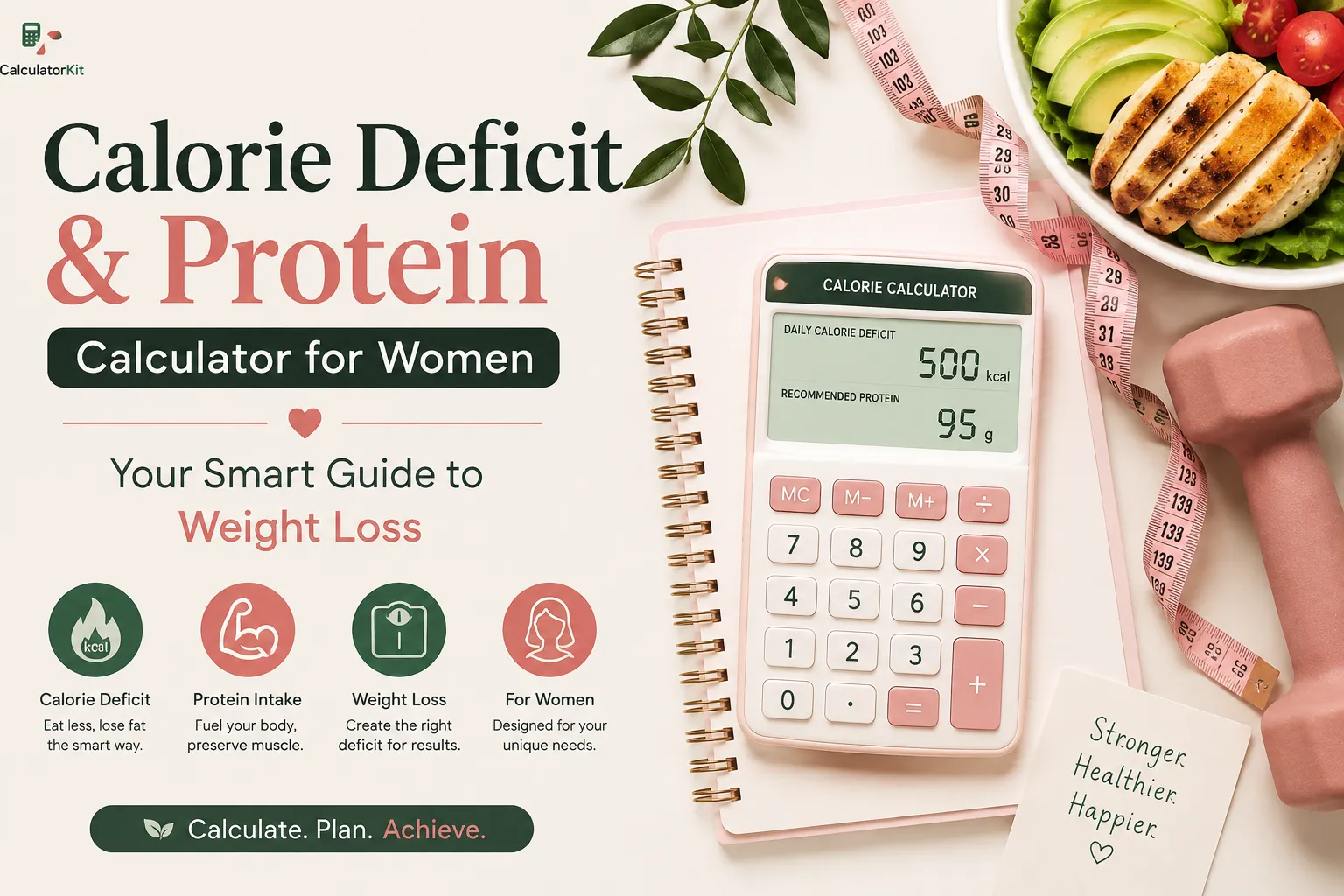
If you have typed “calorie deficit calculator for weight loss” into Google, you are probably tired of generic advice that tells you to “eat less and move more” without explaining the actual numbers. This guide fixes that. You will learn exactly how a calorie deficit calculator works, how many calories to cut for your goal, how much protein your body actually needs while losing fat, and how to turn those numbers into real meals you can eat every day.
This is written specifically for women, because female metabolism, hormones, and muscle mass respond differently to a calorie deficit than the generic “one-size-fits-all” calculators most sites publish. By the end, you will have a personalised framework, not just a definition.
What Does Calorie Deficit Mean?
A calorie deficit means you are eating fewer calories than your body burns in a day, so it has to pull the remaining energy from stored body fat. That is the simple definition. The part most articles skip is what happens after week two, when your body starts fighting back.
When you stay in a deficit for a few weeks, your metabolism slightly adapts downward. This is called adaptive thermogenesis. Your resting metabolic rate can drop by 5 to 15 percent below what a calculator predicts, your daily movement (NEAT, non-exercise activity thermogenesis) often decreases without you noticing, and hunger hormones like ghrelin rise. None of this means the deficit “stopped working.” It means the target needs to be recalculated every few weeks, not set once and forgotten. This single point is the difference between someone who loses weight for two months and stalls, and someone who keeps losing steadily for six months.
How a Calorie Deficit Calculator Works (TDEE Explained)
Every calorie deficit calculator is built on two numbers:
BMR (Basal Metabolic Rate) the calories your body burns just to stay alive: breathing, circulation, cell repair, brain function.
TDEE (Total Daily Energy Expenditure) is your BMR plus calories burned through daily movement, exercise, and digestion.
Your calorie deficit target is simply your TDEE minus a chosen deficit amount. That is the entire mechanism behind every calculator online, whether it is free or paid.
Calculate Your Own Calorie Deficit Manually
Calculate your BMR using the Mifflin-St Jeor formula (the most accurate for most women): BMR = (10 × weight in kg) + (6.25 × height in cm) − (5 × age) − 161.
Multiply your BMR by an activity factor: 1.2 (sedentary, desk job, little exercise), 1.375 (light activity, 1–3 workouts/week), 1.55 (moderate, 3–5 workouts/week), 1.725 (very active, daily training).
The result is your TDEE: the calories that maintain your current weight.
Subtract 300–500 calories from your TDEE to set your deficit target for fat loss.
Recalculate every 10–15 days as your weight drops, because a lighter body burns fewer calories at rest.
Example: A 30-year-old woman, 65 kg, 162 cm, lightly active. BMR ≈ 1,364. TDEE ≈ 1,364 × 1.375 ≈ 1,876 calories. A moderate deficit target would be roughly 1,400–1,570 calories a day.
If you would rather skip the manual math, you can plug your height, weight, age, and activity level straight into a free BMR calculator or a calorie calculator to get your BMR and TDEE instantly, then apply the deficit percentages from this guide on top of that number.
Calorie Deficit to Lose Weight: How Many Calories Should You Cut?
One pound of body fat holds roughly 3,500 calories of stored energy. This is where the “calorie deficit to lose a pound” and “calorie deficit to lose 2 pounds a week” questions come from, but the math only works within safe limits, and it only makes sense once you know what you are working toward. If you have not settled on a target yet, an ideal weight calculator can give you a healthy range to aim for before you pick a weekly loss rate.
Calorie Deficit to Lose 1 Pound a Week
A daily deficit of about 500 calories creates a weekly deficit of roughly 3,500 calories, which lines up with about one pound of fat loss per week. This is the range most nutrition coaches recommend for sustainable, muscle-sparing fat loss in women.
Calorie Deficit to Lose 2 Pounds a Week
This requires roughly a 1,000-calorie daily deficit, which for most women drops intake below what supports energy, hormones, and muscle mass. It is generally only appropriate short-term for women with a higher starting body weight and under professional supervision. For most people, chasing 2 pounds a week backfires through fatigue, hair thinning, irregular cycles, and muscle loss, which slows metabolism further.
Worth knowing: the classic “3,500 calories = 1 pound” rule is a simplification. NIH's Body Weight Planner research found this old rule tends to overestimate real-world weight loss, because your TDEE keeps shifting downward as you lose weight, which is exactly why the recalculation step above matters more than the initial number.
Weekly Goal | Approx. Daily Deficit | Who It Suits | Risk Level |
|---|---|---|---|
0.5 lb/week | 250 kcal | Beginners, small goals, women near goal weight | Low |
1 lb/week | 500 kcal | Most women, sustainable standard | Low–Moderate |
1.5 lb/week | 750 kcal | Higher starting weight, short phases | Low–Moderate |
1.5 lb/week | 750 kcal | Higher starting weight, short phases | Moderate |
2 lb/week | 1,000 kcal | Medically supervised, short-term only | High |
Protein Calculator: How Much Protein Should Women Eat in a Deficit
This is the part most calorie deficit calculators completely ignore, and it is the single biggest factor in whether you lose fat or lose muscle. In a deficit, your body will break down muscle tissue for energy unless protein intake is high enough to protect it. Preserving muscle is also what keeps your metabolism from dropping too fast.
A practical, research-aligned target for women in a fat-loss phase is 1.6 to 2.2 grams of protein per kilogram of body weight, or roughly 0.7 to 1 gram per pound of body weight. This lines up closely with the International Society of Sports Nutrition's position stand on protein, which places 1.4–2.0 g/kg as sufficient for most active adults and notes that the higher end of that range helps protect lean mass during a calorie deficit specifically. Active women and women over 40 (who lose muscle mass faster due to hormonal changes) should aim toward the higher end of the range.
Body Weight | Daily Protein Target (1.6–2.0 g/kg) | Approx. Meals to Hit It |
|---|---|---|
55 kg (121 lb) | 88–110 g | 4 meals with 20–28g protein each |
65 kg (143 lb) | 104–130 g | 4 meals with 26–33g protein each |
75 kg (165 lb) | 120–150 g | 4–5 meals with 25–30g protein each |
85 kg (187 lb) | 136–170 g | 5 meals with 27–34g protein each |
A simple rule that works in real life: build every plate around a palm-sized portion of protein first, then add vegetables and a controlled portion of carbs. This alone solves most of the “I don’t know how to hit my protein” problem without needing to weigh every gram.
Calorie Deficit Diet Plan for Women: The Framework
A calorie deficit diet plan is not about eating “diet food.” It is about structuring normal food, so you stay full on fewer calories. Three principles do most of the work:
Protein first, every meal: protein keeps you full longer and costs your body more energy to digest than carbs or fat.
Volume eating with fibre: vegetables, salads, and broths add bulk and fullness without many calories, so your stomach feels satisfied.
Planned flexibility: one meal a week that is not “on plan” prevents the binge-restrict cycle that derails most deficits within a month.
A Simple Macro Split That Works for Most Women
Protein: 30–35% of total calories
Carbohydrates: 35–45% of total calories (timed around activity/workouts)
Fats: 20–30% of total calories (needed for hormone production, do not go too low)
Best Calorie Deficit Foods (High Volume, High Satiety)
These are foods that give you the most fullness per calorie, which is the real skill behind a sustainable calorie deficit diet:
Lean protein: chicken breast, egg whites plus 1–2 whole eggs, white fish, prawns, Greek yoghurt, cottage cheese, tofu, lentils.
Low-calorie vegetables: spinach, broccoli, cucumber, zucchini, cauliflower, mushrooms, bell peppers, tomatoes.
Smart carbs: oats, sweet potato, brown rice, quinoa, whole fruit (apples, berries, oranges).
Healthy fats (measured, not unlimited): olive oil, avocado, nuts and seeds, nut butter (1 tbsp servings).
Fullness boosters: clear soups, air-popped popcorn, chia seeds, psyllium husk in water before meals.
Calorie Deficit Breakfast Ideas That Actually Keep You Full
Breakfast sets the tone for hunger the rest of the day. A high-protein breakfast reduces snacking later, which is where most deficits are broken.
Greek yoghurt bowl: 150g Greek yoghurt, a handful of berries, 1 tsp chia seeds (~220 kcal, 20g protein).
Veggie egg scramble: 2 whole eggs + 2 egg whites with spinach and tomato, 1 slice whole-grain toast (~300 kcal, 26g protein).
Protein oats: 40g oats cooked in water, 1 scoop protein powder stirred in, cinnamon (~320 kcal, 30g protein).
Cottage cheese toast: cottage cheese on whole-grain toast with sliced cucumber and black pepper (~260 kcal, 22g protein).
Sample Calorie Deficit Meal Plan (1,500 Calorie Example)
This sample is built for a moderately active woman with a TDEE around 2,000 calories, aiming for roughly a 500-calorie daily deficit. Adjust portions up or down based on your own TDEE from the calculator above.
Meal | Example | Approx. Calories | Protein |
|---|---|---|---|
Breakfast | Veggie egg scramble + toast | 300 kcal | 26 g |
Snack | Greek yoghurt + berries | 180 kcal | 17 g |
Lunch | Grilled chicken salad with olive oil dressing | 420 kcal | 35 g |
Snack | Apple + 1 tbsp peanut butter | 180 kcal | 5 g |
Dinner | Baked fish, quinoa, roasted vegetables | 420 kcal | 32 g |
Total: approximately 1,500 calories and 115 grams of protein, enough to satisfy the protein target for most women in the 60–70 kg range while staying in a clear deficit.
Calorie Deficit Apps and Tracking Tools Worth Using
A calculator gives you the target number; a tracking app is what keeps you accountable to it day after day. Look for an app with these features rather than picking one by popularity alone:
A large, verified food database so logging packaged and restaurant food is fast and accurate.
Barcode scanning cuts logging time from minutes to seconds.
Macro breakdown, not just total calories; you need to see protein separately, not just “calories left.”
A weight-trend graph shows daily weight fluctuations from water and sodium; a trend line filters out the noise so you see real progress.
Recipe/meal saving so you are not re-entering the same breakfast every single day.
Popular options that cover these features include MyFitnessPal, Cronometer, and Lose It; pick whichever one you will actually open every day, because consistency of logging matters more than which app you choose.
Common Mistakes Women Make in a Calorie Deficit
These are the patterns that show up again and again with women who stall out or quit a deficit early:
Cutting calories too aggressively from day one: a 1,000+ calorie deficit is not sustainable and usually ends in a binge within two weeks.
Ignoring protein and only watching total calories: this leads to losing muscle along with fat, which shows up as “skinny fat” and a slower metabolism.
Ignoring cycle phases: hunger and water retention naturally rise in the luteal phase (roughly the two weeks before a period); judging progress by the scale during this window causes unnecessary panic.
Never recalculating the deficit as body weight drops, TDEE drops too. Eating the same calories for 4 months straight is why weight loss stalls even with “no cheating.”
Cutting fat too low, under roughly 20% of calories from fat, can disrupt hormone production and menstrual cycles in women.
Judging progress only by the scale, not tracking measurements, photos, or an estimated body-fat percentage, means muscle gain and fat loss happening at the same time (recomposition) looks like “no progress” when it is actually working. A quick body fat calculator every few weeks is a better progress signal than the scale alone.
Over-relying on cardio, skipping strength training and resistance training is what signals your body to keep muscle while calories are lower; without it, more of the weight lost is muscle, not fat.
Conclusion
Losing weight is not about starving yourself; it's about creating the right calorie deficit while eating enough protein and nutrient-rich foods to protect your muscles and health. By understanding your BMR, TDEE, and daily calorie needs, you can build a sustainable fat-loss plan that delivers long-term results. Use a reliable calorie deficit calculator, track your progress every few weeks, and adjust your calorie intake as your body changes. Consistency, balanced nutrition, and realistic goals are the keys to successful and healthy weight loss.
Frequently Asked Questions
Q: What does calorie deficit mean in simple words?
It means eating fewer calories than your body burns in a day, so it uses stored fat for the missing energy. Over time, a consistent deficit leads to weight loss.
Q: How is a calorie deficit calculator different from a TDEE calculator?
A TDEE calculator shows the calories you burn in a day at your current weight. A calorie deficit calculator takes that TDEE number and subtracts a chosen amount, giving you a target for weight loss rather than maintenance.
Q: Can I eat carbs while in a calorie deficit?
Yes. Carbohydrates are not the enemy of fat loss; total calories are what matter most. Carbs also fuel workouts and support strength training, which helps preserve muscle while you lose fat.
Q: Is a calorie deficit diet safe long term?
A moderate deficit of 300–500 calories a day is generally considered safe for most healthy women for several months at a time. Very low-calorie deficits should be short-term and ideally guided by a doctor or registered dietitian, especially if you have a medical condition or irregular periods.
Q: Why did my weight loss stall even though I'm still in a deficit?
Two common reasons: your TDEE has dropped as your body weight has dropped, so your old deficit is now closer to maintenance, or water retention from sodium, stress, or your cycle is temporarily hiding fat loss on the scale. Recalculate your target and look at a 2-week trend, not single days.
Related Articles
Calculate standard error quickly with formulas and examples. Learn SE for means, proportions, two samples, confidence intervals, Excel, and Casio.

Calculate productivity percentage instantly using billable and paid minutes. Learn lunch, concurrent therapy, targets, formulas, and billing units.

Calculate USPS mail delivery time by ZIP code. Compare First-Class, Ground Advantage, Priority Mail, and Express delivery estimates easily.

Use our free cubic feet calculator to calculate box, tank, wood, soil, and storage volume accurately from feet, inches, or cm.