
10 Types of Calculators That Make Life Much Easier
Discover 10 types of calculators that simplify daily tasks, math, finance, health, and more. Find the right calculator to save time and avoid errors.
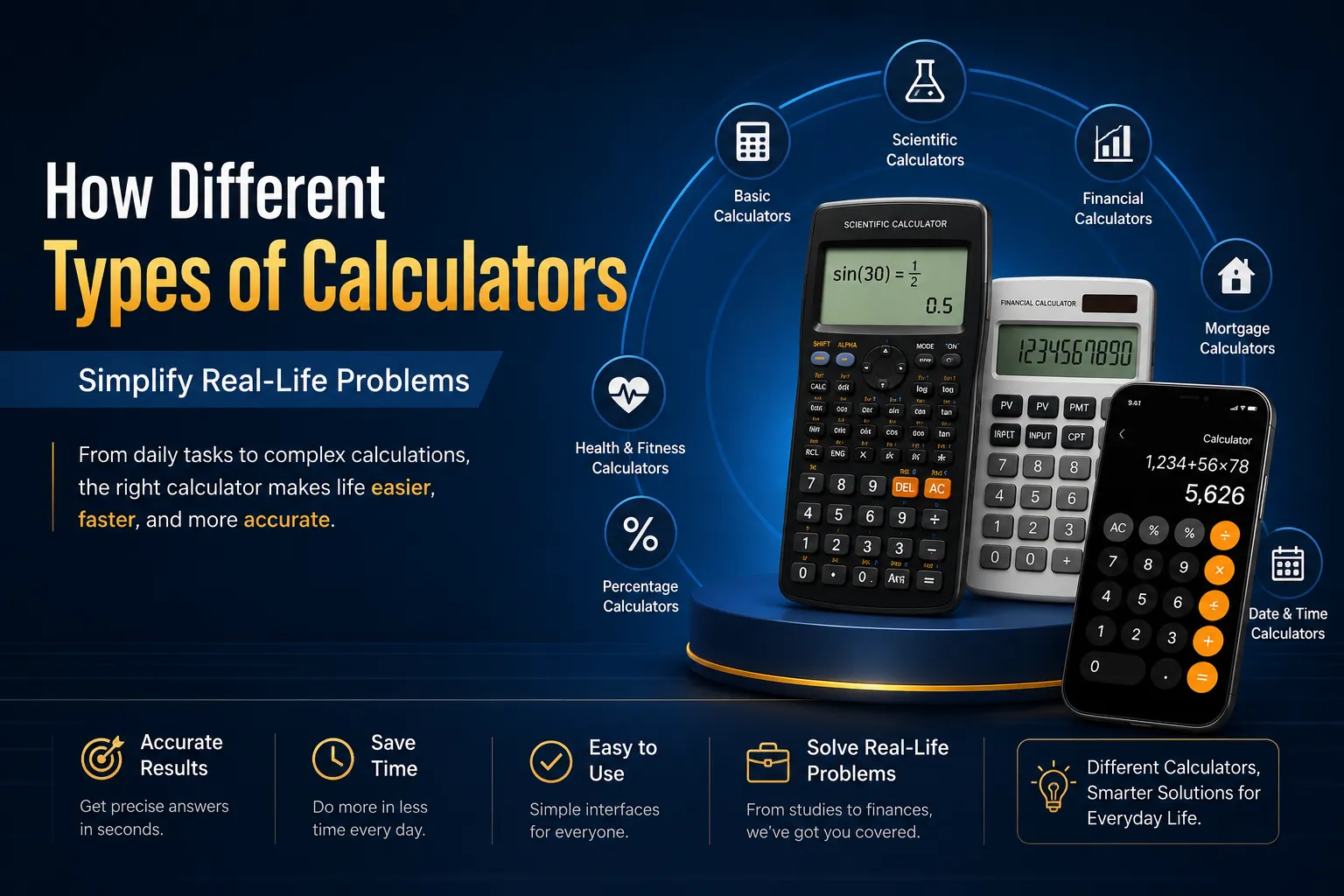
Quick Answer The main types of calculators are basic calculators for everyday arithmetic, scientific calculators for trigonometry and logarithms, graphing calculators for visualising functions, financial calculators for loans and investments, programmable and matrix calculators for engineering, printing calculators for office accounting, and calculator apps for quick digital access. Each type solves a different category of real-life problem. |
What Are the Different Types of Calculators
Every calculator type solves a gap that a general-purpose calculator cannot handle well. A cashier does not need trigonometry, and an engineer cannot rely on a four-function calculator for matrix equations. Knowing the full list stops you from overpaying for features you will never use or underbuying a tool that cannot keep up with your coursework.
Basic calculators: addition, subtraction, multiplication, division, and percentages.
Scientific calculators: trigonometry, logarithms, exponents, and statistics.
Graphing calculators: visual plots used in calculus and advanced statistics.
Financial calculators: loan payments, interest, and investment returns.
Programmable and matrix calculators: custom formulas and linear algebra.
Printing calculators: paper tape output for accounting and cash handling.
Calculator apps: mobile and browser tools covering any category above.
Basic Calculators for Everyday Life
A basic calculator solves the arithmetic that fills an ordinary day, splitting a restaurant bill, checking a discount at checkout, or adding up a grocery total before reaching the till. It rarely goes beyond the four core operations, percentages, and a memory function. Most households keep one in a kitchen drawer, and most phones include one by default, which is why basic calculators remain the most used type despite being the least advanced.
Scientific Calculators for School and Work
A scientific calculator adds trigonometric functions, logarithms, exponents, and statistics on top of basic arithmetic. Most middle and high school math courses require one starting around algebra, since these courses introduce functions that a basic calculator cannot compute. Lab technicians and pharmacy students also rely on it daily for unit conversions. Check your syllabus first, since some exams restrict specific models.
Graphing Calculators for Advanced Math
A graphing calculator plots functions visually, which makes abstract calculus and statistics far easier to understand than working through equations on paper alone. Students see exactly where a curve crosses zero or how a data set clusters, instead of only calculating the numbers behind it. Many standardised exams require or permit graphing calculators, so check exam rules before buying one.
Financial Calculators for Money Decisions
A financial calculator handles loan payments, interest, amortisation schedules, and investment returns far faster than a scientific calculator or spreadsheet built from scratch. Real estate agents use them to estimate mortgage payments with a client. Business owners compare loan offers before signing anything. Finance students use them throughout coursework, since manual time value of money calculations eat up exam time better spent solving the actual problem.
Programmable and Matrix Calculators
Programmable calculators let engineers and advanced students store custom formulas directly on the device, saving time on repeated calculations during exams or fieldwork. Matrix calculators, often built into the same higher-end models, solve systems of linear equations common in engineering coursework. These calculators cost more and carry a steeper learning curve, so they suit users who already understand the underlying math.
Printing Calculators for Offices
A printing calculator produces a paper tape record of every calculation, which matters in accounting and cash handling roles where a reviewable trail prevents costly errors. Bookkeepers use the tape to double-check a long column of figures without retyping every number. Retail back offices use them to reconcile cash drawers. Even in a digital accounting world, many finance teams keep one on a desk for this reason.
Calculator Apps and Online Tools
Calculator apps now cover nearly every category above, from a basic phone app to a full graphing calculator running in a browser tab. The advantage is access, since a phone stays in your pocket while a dedicated device might sit in a bag. The tradeoff is that some exams ban phone-based calculators entirely, so never assume an app can replace an approved device during a test.
Comparison Table: Which Calculator Fits Which Problem
Use this table to match a real problem to the right calculator type.
Calculator Type | Best For | Typical User |
|---|---|---|
Basic | Daily arithmetic and percentages | Households, cashiers, students |
Scientific | Trigonometry, logarithms, exponents | High school and college students |
Graphing | Visualising functions and statistics | Calculus and statistics students |
Financial | Loans, interest, investment returns | Finance students, agents, business owners |
Programmable and matrix | Custom formulas and linear algebra | Engineering and advanced math students |
Printing | Auditable calculation records | Bookkeepers and retail cash handling |
Apps | Quick access across categories | Anyone with a phone or browser |
Popular Calculator Brands Compared
Casio and Texas Instruments, often shortened to TI, lead the education market, though they approach the problem differently. Casio calculators tend to cost less and offer natural textbook display formatting, making fractions look the way they appear in a printed book. TI models, especially the TI 84 series, dominate United States classrooms partly because so many teachers already know the interface. HP remains the standard in finance, particularly the HP 12C, which professionals still use decades after release because its input method becomes fast once learned. Sharp holds a strong position in printing calculators, valued for durability over advanced functions.
Choosing a Calculator for High School Versus College
High school students typically need a scientific calculator starting in algebra, moving to a graphing calculator once precalculus or calculus begins, since many standardised tests specifically permit graphing models. College changes the picture by major. A business student usually needs a financial calculator more than a graphing one, while an engineering student often needs a graphing or programmable model capable of matrix operations. Before buying anything for a new course, check the syllabus, since a banned calculator cannot help you on test day.
Mistakes People Make When Choosing a Calculator
Buying a graphing calculator for a course that only needs a scientific one.
Assuming a phone app will be allowed during an exam, when many tests ban phone-based calculators.
Choosing a calculator based on brand loyalty instead of checking course requirements.
Ignoring battery type before a big exam, since a dead solar-only calculator becomes useless.
Learning a financial calculator's input method the night before a decision instead of practising early.
Conclusion
How different types of calculators simplify real-life problems comes down to matching the tool to the task rather than assuming one calculator should handle everything. A cashier, a calculus student, and a mortgage broker are solving completely different problems, and each has a calculator type built specifically for it.
To put this guide into action:
Identify which category matches your coursework or job before buying anything.
Check your syllabus or exam rules for required or banned calculator types.
Practise with any new calculator before you need it under real pressure.
Frequently Asked Questions
Q: What are the main types of calculators?
The main types are basic, scientific, graphing, financial, programmable, matrix, printing, and calculator apps, each built for a different problem.
Q: What type of calculator is used in high school?
Most high school students use a scientific calculator starting in algebra, then move to a graphing calculator for precalculus and calculus.
Q: What type of calculator is used in college?
It depends on the major. Business students often use financial calculators, while engineering students typically need graphing or programmable models.
Q: Which calculator brand is best, Casio or TI?
Neither is universally better. Casio tends to cost less with a clear textbook display, while TI models are more common in United States classrooms.
Q: Can I use a calculator app instead of a physical calculator?
For daily tasks, yes. For exams, check the rules first, since many standardised tests ban phone-based calculator apps entirely.
Q: What is a financial calculator used for?
A financial calculator handles loan payments, interest, amortisation schedules, and investment return calculations faster than a scientific calculator.
Q: Do I need a graphing calculator for calculus?
Many calculus courses and exams either require or specifically permit graphing calculators, so check your syllabus before buying one.
Q: What is the difference between a scientific and a graphing calculator?
A scientific calculator computes functions such as trigonometry and logarithms, while a graphing calculator also displays those functions as plotted curves.
Related Articles
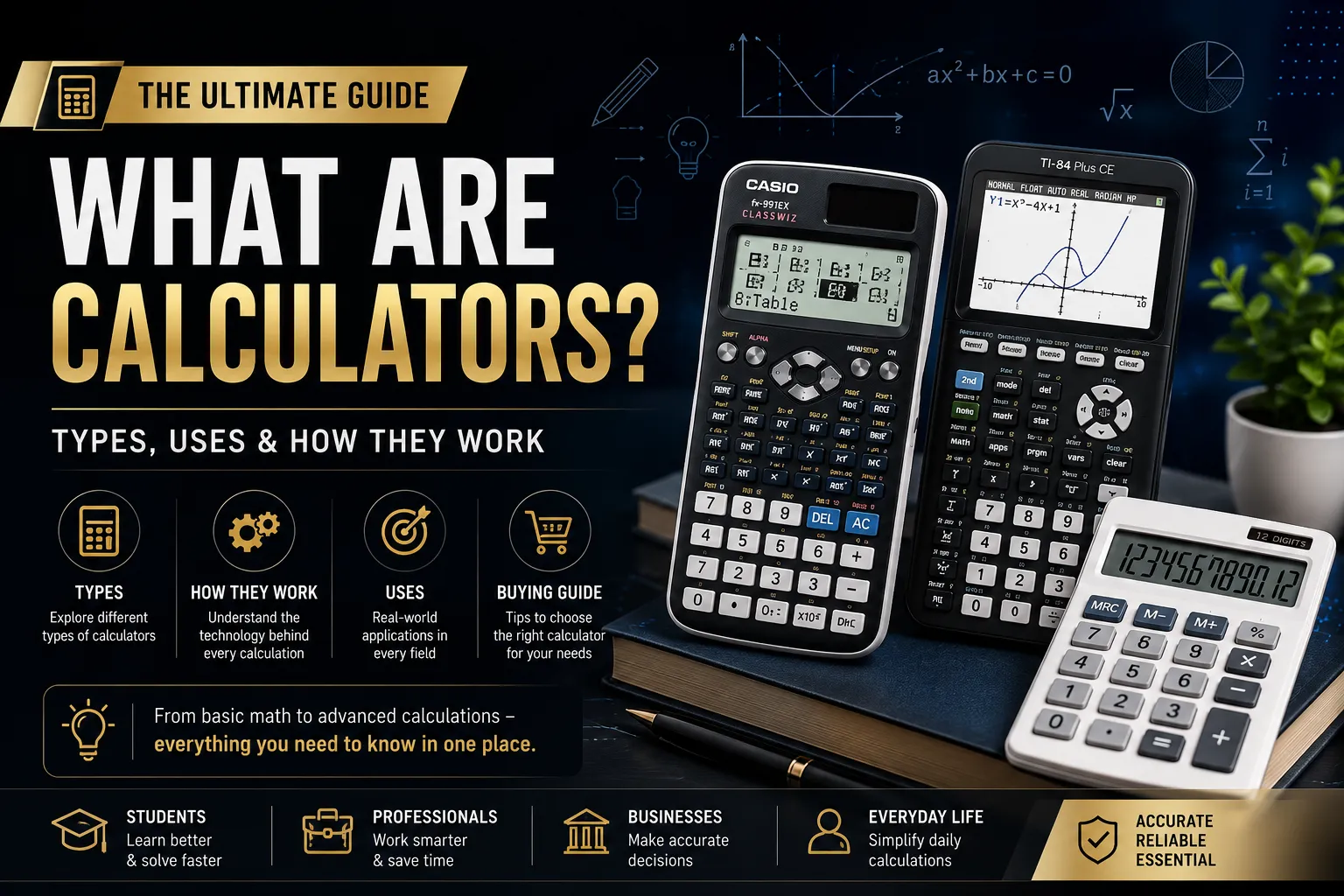
Learn what calculators are, how they work, their types, uses, key features, and how to choose the right calculator for school, work, or everyday tasks.

Use our free Health Calculator to calculate BMI, BMR, and TDEE instantly. Get accurate calorie needs, healthy weight insights, and fitness results.
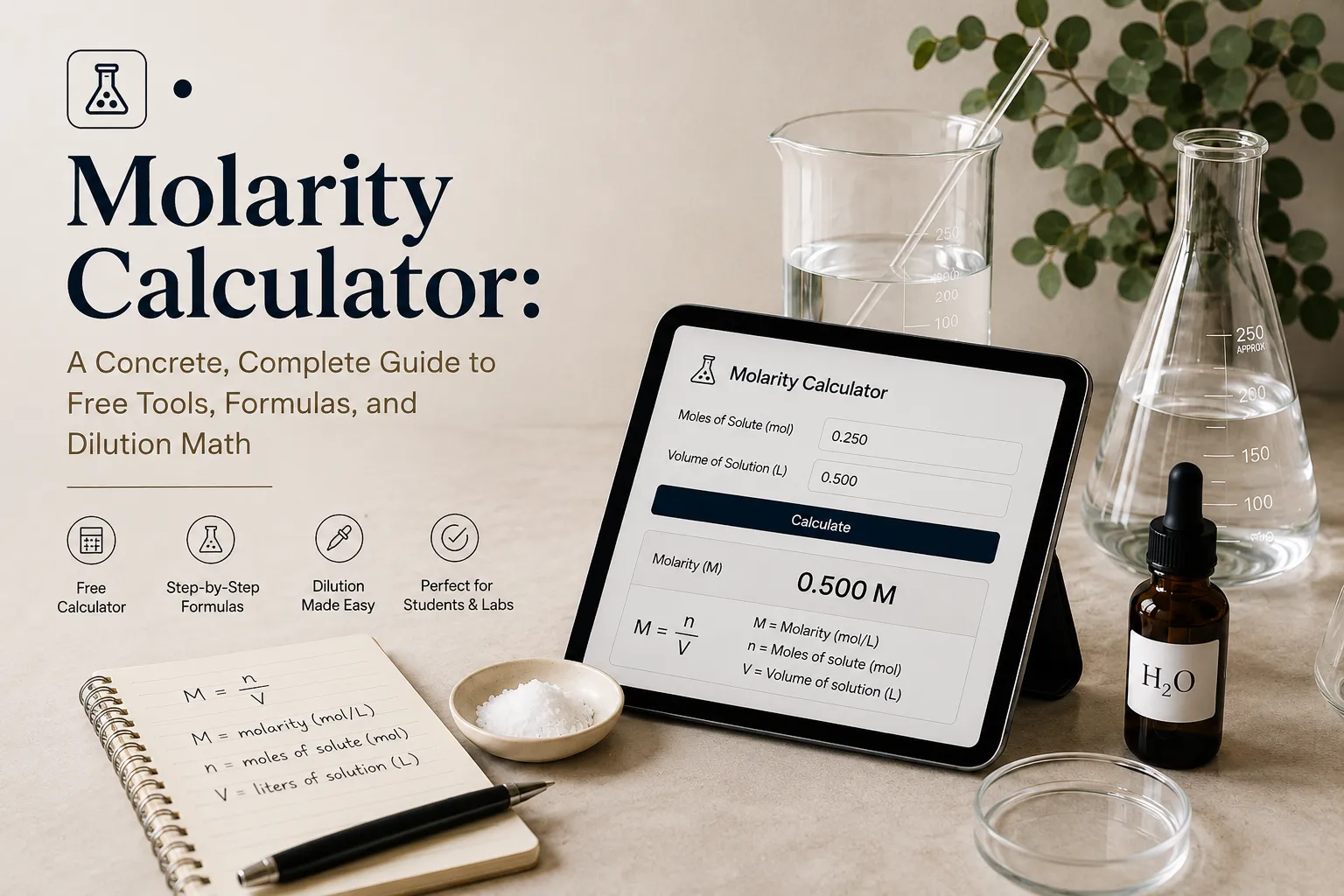
Use our free Molarity Calculator to find solution concentration instantly. Learn the formula, solve examples, and avoid common chemistry mistakes.
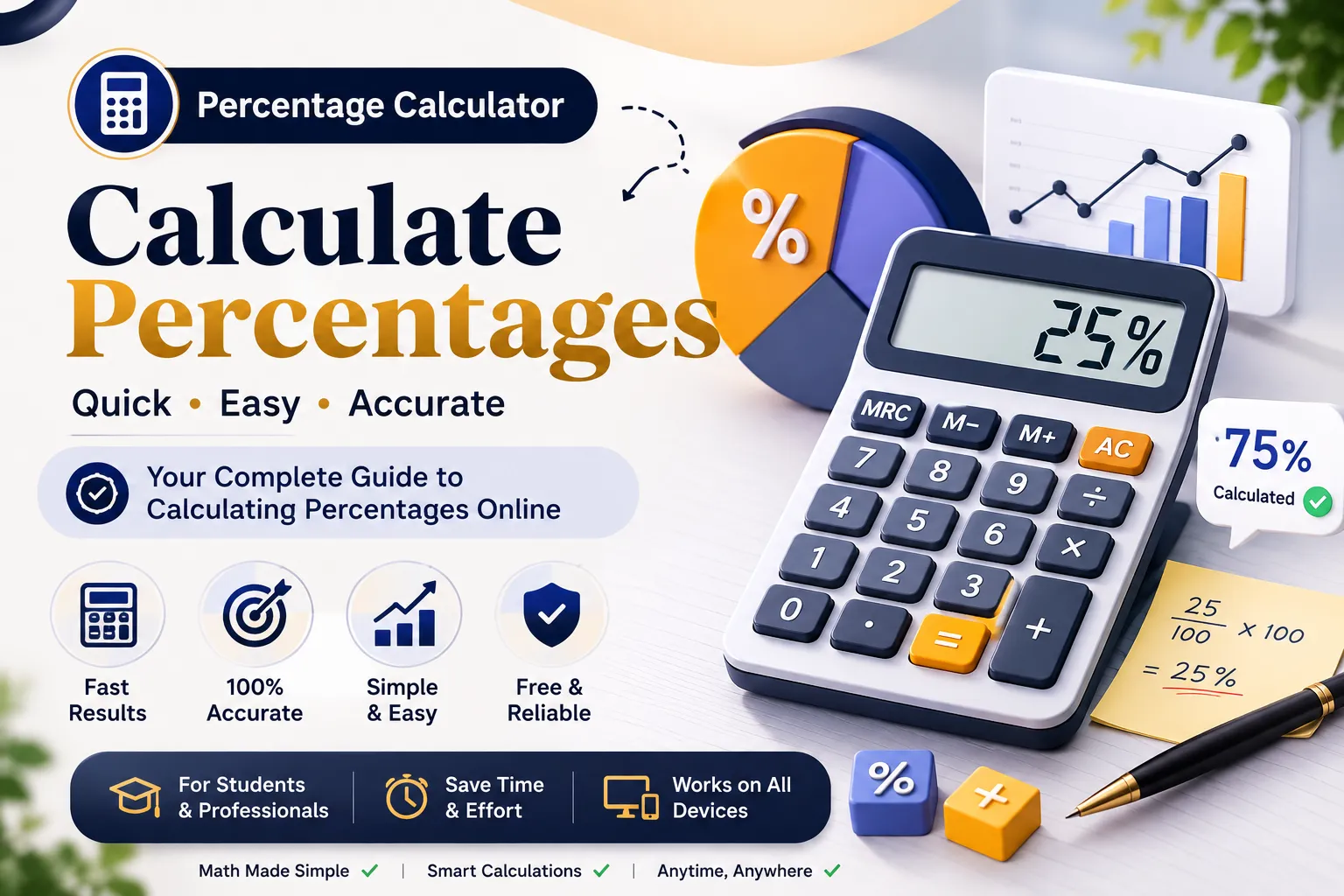
Learn how to calculate percentages with easy formulas, step-by-step examples, discounts, grades, percentage increase, decrease, and Excel formulas.