
How to Calculate a Car Loan Payment: Easy Formula, Examples & Tips for 2026
Learn how to calculate a car loan payment using APR, interest, loan term, trade-in, and simple formulas. See examples and avoid costly mistakes.
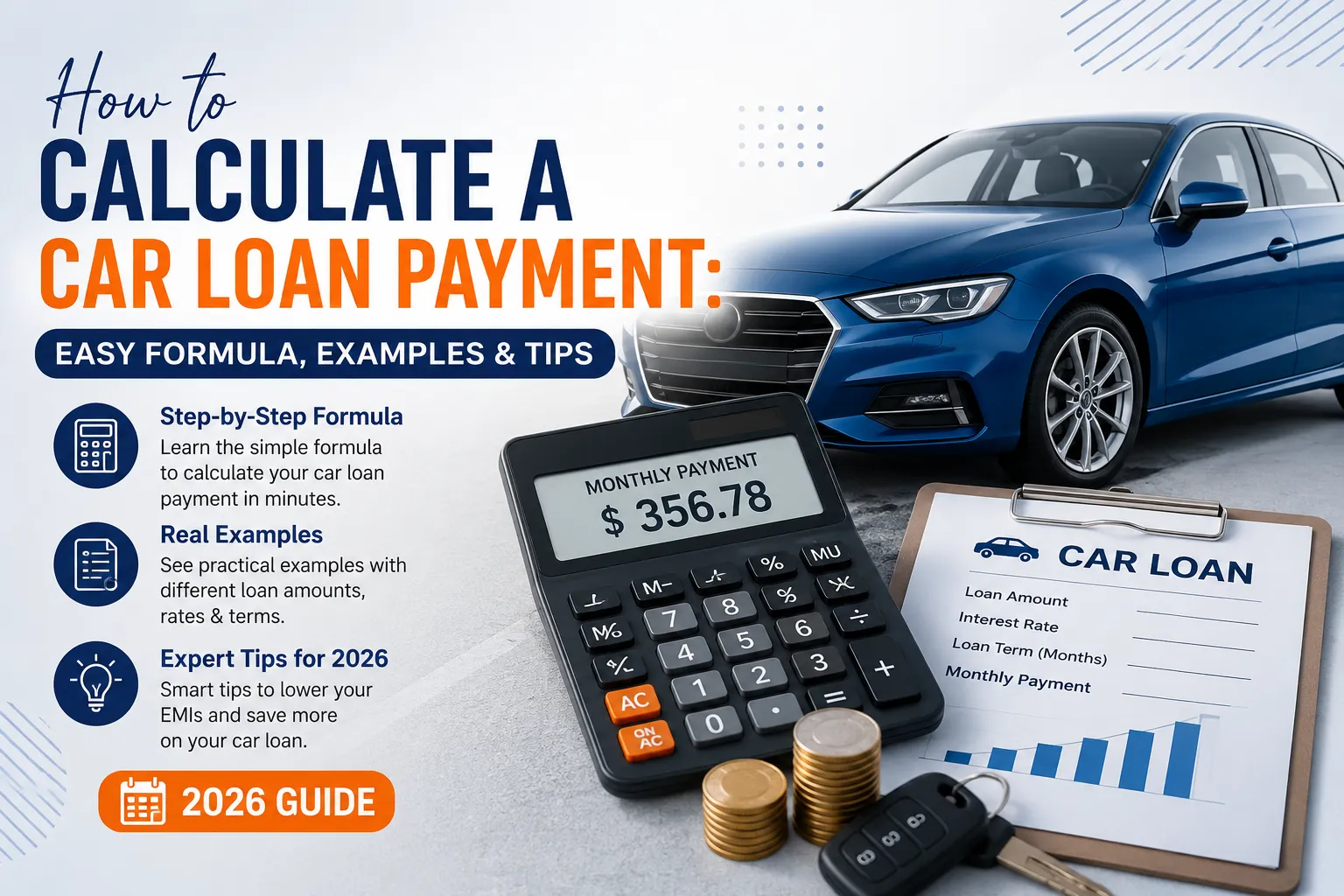
If you have ever typed “how to calculate a car loan payment” into Google right before walking into a dealership, you already know the problem: every online calculator gives you a number, but almost none of them explain how that number is actually calculated. That gap costs buyers real money, because a monthly payment is not just “price divided by months.” It is a formula built from the principal, interest rate, loan term, and, in many deals, a trade-in value that dealers often bury in the math.
This guide breaks down exactly how to calculate an auto loan payment by hand, in Excel, and with a trade-in, and it shows you how lenders actually compute the interest portion of every installment. By the end, you will be able to check any dealer quote in under two minutes and know immediately if the numbers add up.
If you would rather skip the manual math altogether, our free Vehicle Loan Calculator instantly runs the exact formula below, including trade-in and down payment fields. The walkthrough that follows explains what is happening behind that calculator, so you can sanity-check any number a dealer gives you.
What Actually Determines Your Car Loan Payment
Before touching any formula, it helps to understand the four variables that control every car loan payment. Change any one of them, and the payment changes accordingly.
Principal (loan amount): the vehicle price minus your down payment and trade-in equity.
Annual Percentage Rate (APR): the yearly interest cost, which includes the interest rate plus most lender fees.
Loan term: the number of months you are repaying, usually 36 to 84 months.
Interest calculation method: most auto loans use simple interest on a reducing balance, but some regions and dealer financing plans use a flat rate, which produces a noticeably higher effective cost.
Most online guides stop at the formula. The part that actually saves you money is understanding how these four variables interact; for example, stretching a loan from 60 to 72 months usually lowers the monthly payment but increases total interest paid, sometimes by more than a thousand dollars. A calculator will not warn you about that trade-off; you have to check it yourself.
The Car Loan Payment Formula (Manual Calculation)
Auto loans use the standard amortized loan formula. This is the same formula lenders, banks, and spreadsheet PMT functions rely on internally.
M = P × [ r(1+r)^n ] / [ (1+r)^n − 1 ]
What each part means
M = your monthly payment
P = principal, the amount you are actually borrowing
r = monthly interest rate (annual rate ÷ 12, expressed as a decimal)
n = total number of monthly payments (loan term in years × 12)
Worked example
Say you are financing a car with these numbers:
Loan amount (P): $25,000
APR: 6%
Term: 60 months (5 years)
Convert the annual rate to a monthly rate: 6% ÷ 12 = 0.5%, or 0.005 as a decimal.
Raise (1 + r) to the power of n: (1.005)^60 ≈ 1.3489.
Multiply the top of the formula: 0.005 × 1.3489 = 0.006745, then multiply by P: 0.006745 × 25,000 = 168.62.
Work out the bottom of the formula: 1.3489 − 1 = 0.3489.
Divide: 168.62 ÷ 0.3489 ≈ $483.32 per month.
That is your monthly payment before taxes, registration fees, or add-on products the dealer may include. Multiply $483.32 by 60, and you get $28,999.20 total repaid, which means the total interest cost over the life of the loan is about $3,999.20.
In India and several other markets, this same monthly figure is called an EMI (Equated Monthly Installment). The name is different, but it comes from the identical amortization formula shown above, so everything in this guide applies whether you call it a car payment or an EMI. If you want to run several rate or term scenarios quickly, the Auto Loan Calculator applies this formula automatically and shows the full amortization breakdown.
How to Calculate an Auto Loan Payment With Interest, the Easy Way
If doing the exponent math by hand is not practical, use this five-step workflow instead. It is the same process finance professionals use when they do not have a financial calculator handy.
Confirm your true principal. Subtract your down payment and any trade-in equity from the vehicle’s out-the-door price, including tax, title, and dealer fees, since these are usually rolled into the loan.
Get the real APR, not the “interest rate.” Dealers sometimes quote a lower rate and quietly add fees elsewhere; the APR is the number that reflects your true borrowing cost.
Divide the APR by 12 to get your periodic monthly rate.
Multiply your loan term in years by 12 to get total payments.
Plug the three numbers into the formula above, or into a spreadsheet PMT function (covered below) so you are not doing exponents by hand.
Practitioner tip: always calculate your payment using the APR the lender discloses on the official loan disclosure, not the number quoted verbally on the sales floor. In the U.S., the Truth in Lending Act requires this disclosure, and it is the only number that reliably matches the amortization schedule you will actually receive.
For a full breakdown of what lenders are legally required to disclose before you sign, the Consumer Financial Protection Bureau's auto loan resource is a reliable, unbiased place to check current disclosure rules and shopping tips.
How to Calculate Total Car Loan Interest Paid
Buyers frequently want to know two different numbers, and it is easy to confuse them: the interest paid in a single month, and the total interest paid over the entire loan.
Interest paid in any single month
Multiply your current remaining balance by the monthly interest rate. Early in the loan, more of your payment goes toward interest because the balance is still high; later, more goes toward principal.
Month 1 interest example: $25,000 × 0.005 = $125.00
Principal paid that month: $483.32 − $125.00 = $358.32
New balance: $25,000 − $358.32 = $24,641.68
Total interest paid over the life of the loan
Total interest = (monthly payment × number of payments) − original principal. Using the earlier example: (483.32 × 60) − 25,000 = $3,999.20 in total interest.
Flat Rate vs. Reducing Balance: Why the Same Rate Can Mean Different Payments
This is the part most car loan guides skip entirely, and it matters a great deal if you are comparing dealer financing across different countries or lender types, including financing structures common in Singapore, Malaysia, and India.
Method | How interest is charged | Effective cost |
|---|---|---|
Reducing balance | Interest is charged only on the remaining loan balance each month | Matches the quoted APR closely |
Flat rate | Interest is charged on the full original principal for the entire term | Roughly 1.8× to 1.9× higher than the quoted flat rate |
Under a flat rate car loan, if you borrow $25,000 at a 6% flat rate for 5 years, the lender adds interest as: $25,000 × 6% × 5 = $7,500 total interest, spread evenly across 60 months. Compare that to the $3,999.20 in interest from the reducing-balance example above using the same headline rate. The flat-rate loan costs almost double, even though the advertised rate looked identical.
Always ask the lender directly: “Is this a flat rate or a reducing balance (diminishing balance) rate?”
If you are only given a flat rate, convert it to an approximate effective annual rate by roughly doubling it before comparing offers.
This distinction is the single biggest reason two loans with the “same” interest rate can have very different real costs.
How to Calculate a Car Payment With a Trade-In
Trade-ins change your principal, not your interest rate, so the formula stays identical; only the P value changes. Here is the correct order of operations, since doing this in the wrong sequence is one of the most common buyer mistakes.
Start with the vehicle’s negotiated price plus tax, title, and fees.
Subtract your trade-in’s actual value (its market value, not the payoff amount).
If you still owe money on the trade-in, add that remaining loan balance back to your new loan amount; this is called negative equity, and it is easy to overlook.
Subtract your cash down payment.
The number left over is your true principal (P) to plug into the payment formula.
Example: a $30,000 car, trade-in worth $8,000 with a $2,000 payoff remaining, and a $2,000 cash down payment. New principal = $30,000 − $8,000 + $2,000 − $2,000 = $22,000. That $22,000 is what actually gets financed, not the sticker price.
The Vehicle Loan Calculator has separate trade-in and negative-equity fields, so you can plug in your own numbers and see the adjusted principal without doing this arithmetic by hand.
How to Calculate Your Auto Loan Payoff Amount
Your payoff amount is rarely the same as your current statement balance, because interest accrues daily between your last payment and the day you pay it off.
Find your current principal balance from your most recent statement.
Calculate the daily interest rate: APR ÷ 365.
Multiply the daily rate by your remaining balance, then by the number of days since your last payment.
Add that accrued interest to your remaining balance to get the true early payoff figure.
Example: $10,000 balance, 6% APR, 20 days since last payment. Daily rate = 0.06 ÷ 365 = 0.0001644. Accrued interest = 10,000 × 0.0001644 × 20 ≈ $32.88. Payoff amount ≈ $10,032.88.
If you are deciding whether an early payoff is worth it compared with investing that cash elsewhere, the general-purpose Loan Calculator can model the remaining schedule under different extra-payment amounts.
How to Calculate a Car Loan Payment in Excel or Google Sheets
Spreadsheets remove all the manual exponent work and let you test different scenarios instantly, which is the fastest way to compare loan offers side by side.
Open a blank sheet and label three cells: Loan Amount, Annual Rate, Term (Months).
Enter your numbers, for example 25000, 6%, and 60.
In a new cell, type: =PMT(rate/12, term, -loan_amount) referencing your three cells.
Press Enter. The formula returns your monthly payment as a positive number.
To see total interest, add a cell with: =(payment_cell*term_cell)-loan_amount_cell.
The negative sign in front of the loan amount is required because Excel’s PMT function treats the loan as money you receive and the payment as money going out; without it, your result will show as negative.
Common Mistakes People Make When Estimating a Car Payment
These mistakes show up constantly in dealership transactions, which is also why the Federal Trade Commission's guide to financing or leasing a car recommends getting your APR and out-the-door price in writing before any financing discussion begins.
Using the sticker price instead of the out-the-door price, which excludes tax, title, and dealer add-ons that get rolled into the loan.
Confusing interest rate with APR, especially when a dealer quotes “buy rate” without disclosing markup.
Forgetting negative equity from a trade-in, which silently inflates the real loan amount.
Assuming a lower monthly payment always means a better deal, without checking the total interest over a longer term.
Applying the flat-rate formula to a reducing-balance loan (or vice versa), which produces a payment estimate that is off by hundreds of dollars a month.
Skipping the amortization schedule and only looking at the monthly payment, which hides how slowly the balance actually drops in the first year.
Conclusion
Calculating a car loan payment is not about memorizing a formula; it is about knowing which number to trust. Once you understand how principal, APR, term, and interest method fit together, you stop relying on whatever figure a dealer hands you and start verifying it yourself in under two minutes. That single habit is the difference between financing a car and overpaying for one.
Frequently Asked Questions
Q: How do I calculate my car loan payment with interest rate manually?
Convert your annual rate to a monthly rate by dividing by 12, then use the amortization formula M = P × [r(1+r)^n] / [(1+r)^n − 1], where P is your loan amount, and n is the total number of monthly payments.
Q: How do I calculate car loan interest paid per month?
Multiply your current remaining balance by the monthly interest rate (APR ÷ 12). The result is the interest portion of that month’s payment; the rest reduces your principal.
Q: How do I calculate car loan interest by hand without a calculator?
Use the flat-rate shortcut for an estimate: Principal × Annual Rate × Loan Term in Years gives you a rough total interest figure, though it runs higher than the true reducing-balance cost, so treat it as an upper-bound estimate rather than an exact number.
Q: Does a longer loan term always cost more in total interest?
Usually yes, because interest keeps accruing on a balance that takes longer to pay down, even if the rate stays the same. A 72-month loan typically costs more in total interest than a 48-month loan for the same amount and rate.
Related Articles

See WhatsApp API pricing in 2026, cost per message, Meta fees, BSP markups, Pakistan rates, and how to calculate your monthly WhatsApp API cost.
Calculate standard error quickly with formulas and examples. Learn SE for means, proportions, two samples, confidence intervals, Excel, and Casio.
Use a free overtime calculator to calculate overtime pay from an hourly or monthly salary. Learn formulas, rates, Pakistan rules, and common mistakes.

Learn how to calculate age by DOB accurately with simple formulas, Excel DATEDIF, and SQL. Find your exact age today or on any specific date.